
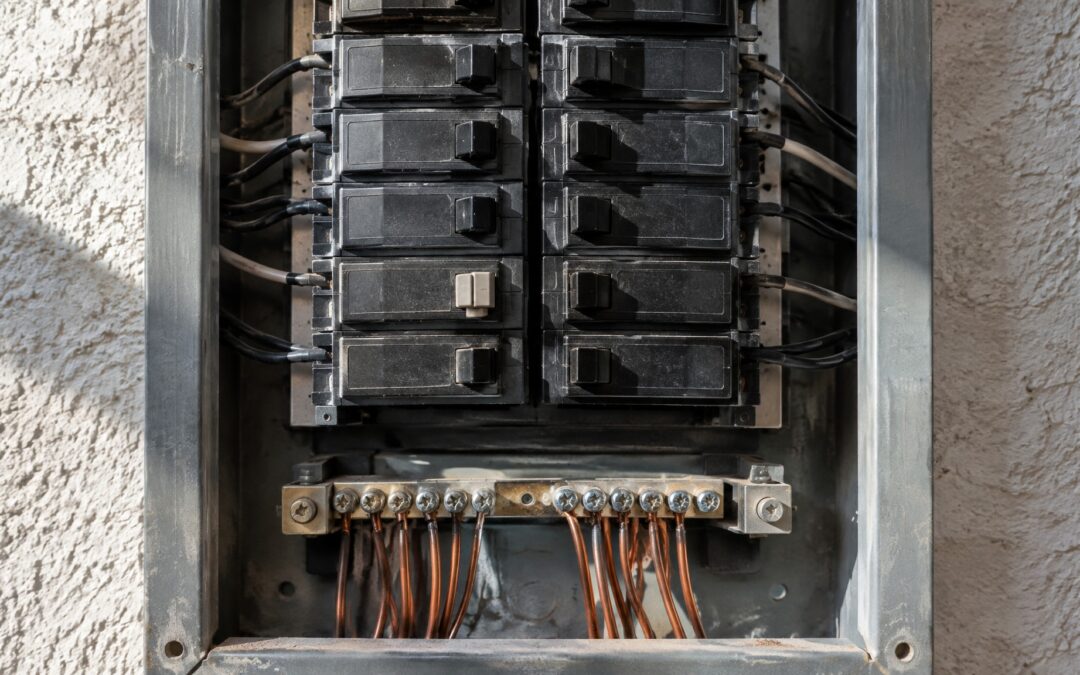
Southwest Florida is hard on electrical equipment. Summers run the air conditioner nearly around the clock, the humidity gets into everything, and plenty of homes in Fort Myers, Cape Coral, Naples, and Estero have panels that were never sized for today’s loads. That is why breaker panel warning signs deserve attention here sooner than they might in a milder climate.
I’m not trying to scare you. Most of these symptoms have a simple cause, and a licensed electrician can tell you which one you’re dealing with.
Still, the signs you need an electrical panel upgrade are worth knowing. A few are urgent, and the rest are easy to ignore until they aren’t. Here are seven, starting with the most common.
Breakers That Keep Tripping
A breaker that trips is doing its job. What matters is why it keeps happening, and the answer sits in one of two places.
One Breaker That Trips Again and Again
When the same breaker trips over and over, the cause is usually one overloaded or faulty circuit. Picture a kitchen circuit feeding a microwave, a toaster, and a coffee maker at once, or a loose connection behind a single outlet. The panel itself may be perfectly healthy.
Resetting it again and again is not a fix. Neither is fitting a larger breaker, because the wire in the wall is rated for the original size and a bigger breaker lets that wire overheat before anything trips.
If one worn-out breaker is the whole problem, that is a much smaller job than a new panel. You can see how the two compare in our guide to breaker replacement costs in Florida.
When the Main Breaker Trips
The main breaker is a different story. It protects the whole service, so when it trips, the entire house goes dark, and the cause may be the total load instead of one circuit.
If yours trips on hot afternoons when the AC, the dryer, and the oven are all running, or trips with nothing unusual on, have a licensed electrician look at it. A main breaker that won’t stay on, or feels hot, is not a reset-and-hope situation.
Vinny, our founder, is a third-generation home services professional, and the first thing he sorts out on any tripping call is whether the trouble is one circuit or the whole panel. A licensed diagnosis checks the load on each circuit and the condition of the panel before anyone recommends replacement, so one symptom does not automatically mean you need an upgrade.
Lights That Flicker or Dim When Appliances Start
Dimming lights are easy to shrug off, especially in a house that has always done it. Where the dimming happens tells you a lot.
Whole-House Flicker or a Single Fixture
If the lights across the house dip every time a big load kicks on, such as the AC compressor starting up, the service may be struggling to carry it. That points toward the panel, the service wiring, or the connections feeding them.
One fixture flickering is usually a different matter. The bulb, the fixture, or the wiring to that one spot is the likelier culprit, and a new panel won’t help it.
That is the honest limit of this sign. Flickering alone doesn’t prove you need an upgrade, and we would rather tell you so than sell you one.
Notice when it happens, because that detail helps the electrician. For the wider list of causes, our flickering lights safety guide walks through them.
Warm, Scorched, or Burning-Smelling Panels
This is the one sign I’d ask you not to wait on. Of all the panel upgrade warning signs, heat and burning smells usually point to a loose or overheating connection, and that is a safety problem before it is an upgrade question.
Licensed electricians generally treat a warm, discolored, or scorched panel as urgent, not something to watch over time. Florida makes it worse, because humidity and coastal salt air speed up the corrosion behind these symptoms, so older panels here deserve an earlier look.
Heat, Discoloration, and Scorch Marks
Feel the outside of the panel door with the back of your hand. If it’s warm, or you can see brown or black marks around a breaker, treat it as urgent.
Don’t open the panel, and don’t touch a breaker that feels warm. The parts inside can hurt you even with the power off at the main, and that work belongs to a licensed professional.
Call a licensed electrician right away. If you’re wondering why this can’t go to a handyman, we cover why panel work calls for a licensed electrician in a separate piece.
Burning Smells, Buzzing, or Crackling
A faint burning or hot-plastic smell near the panel, a steady buzz, or crackling when a load comes on all suggest a connection that isn’t seating properly. It’s the same family of problem as the heat above.
Stay calm, keep your family away from the panel, and call us or another licensed electrician now. If you see smoke or flames, leave the house and call 911 first.
Fuses Instead of Breakers: A Fuse Box Replacement Sign
One of the plainest old electrical panel signs is a fuse box that is still in service. Fuse boxes predate modern breaker panels, so they carry less capacity and give less dependable protection for the way we use power today.
Many of them still seem to work, and that is part of the trouble. A fuse box can run for years while quietly falling behind on safety and capacity.
If a fuse keeps blowing, it is telling you something. Putting in a larger fuse to stop it removes the very protection the fuse exists to give, and the wiring behind it can overheat with nothing to stop it.
This doesn’t mean every fuse box is about to fail. It means a fuse box is a strong reason to schedule a licensed inspection and plan the replacement on your terms, not during an emergency.
An Outdated Electrical Panel Brand Long Flagged for Breaker Problems
Some panels worry electricians because of who made them, not just how old they are.
Older Federal Pacific and Zinsco Panels
Older Federal Pacific Stab-Lok and Zinsco panels have long been flagged by electricians and home inspectors because their breakers may not trip when they should. A breaker that fails to trip is a breaker that isn’t protecting the wire behind it.
Look at the label on the panel door or inside the cover plate. If you see either name, ask a licensed electrician to take a look.
Age alone does not settle the question, though. A well-kept older panel from a trusted maker can be fine, while a newer one in a damp garage can have problems. Brand, condition, and the home’s load matter more than the year on the label.
This comes up often in older Southwest Florida homes, and buyers meet these panels during due diligence more than anyone. If you’re shopping for a house, an electrical inspection before you buy can catch one before closing.
A Full Panel With No Room for New Circuits
Open slots are how a panel grows with a house. When there are none, and the breakers are crowded together, adding a remodel circuit, a new appliance, or a dedicated line gets hard to do safely.
A full panel and a service that is too small are two different problems, and they show up differently. A full panel runs out of physical space. A too-small service runs out of capacity, which shows up as a main breaker tripping or lights dimming under load.
Some homes have one, some have both. A licensed electrician should check both before anyone plans an upgrade.
Whether the answer is a subpanel or a full upgrade is the electrician’s call, not the homeowner’s. If you’ve been tempted to double up wires on a breaker to squeeze in one more circuit, please don’t.
Adding an EV Charger or Mini-Split Can Signal an Electrical Panel Upgrade
This sign is about capacity, not any one appliance. Air conditioning is typically one of the largest electrical loads in a Florida home, and each new big load adds to it.
Cooling Season Load on an Older, Smaller Service
An older, smaller service may handle your house just fine in January. Then July arrives, the compressor runs for hours, and the dryer and oven join in on top of it.
If you notice the main breaker tripping or the lights dimming mostly in the cooling season, your service may be working at its limit. That is the pattern to mention when you call.
New Loads: EV Chargers, Mini-Splits, and Electric Ranges
An EV charger, a new mini-split, or an electric range can push an older, smaller service past what it can carry. Plenty of homes take these additions without any panel work, so a new charger doesn’t automatically mean an upgrade.
Before recommending anything, the electrician runs a load calculation. It adds up what the home already draws and what you plan to add, and that number decides whether the panel needs help.
If you’re planning a charger, our page on EV charger installation in Southwest Florida explains how that install works and when capacity comes into it.
If you smell burning or see scorch marks, call a licensed electrician now. Several milder signs together, like a full panel, a flickering house, and an old fuse box, are a good reason to book an inspection when it suits you. For pricing and timing, our panel upgrade cost guide lays it out, and when you’re ready for a visit, you’ll find trusted local electrical services in Fort Myers waiting for you. We’re neighbors, and there’s no pressure here, just an honest look at what your panel needs.
Frequently asked questions
How much does it cost to replace an electrical breaker box?
The price depends on the size of the panel, the condition of the wiring and service behind it, and what the home needs to carry. A licensed electrician can quote it accurately only after seeing the panel. Our panel upgrade cost guide breaks down what drives the price.
Should a 50-year-old electrical panel be replaced?
Not automatically. Age alone doesn’t decide it, because brand, condition, and your home’s load matter more. A 50-year-old Federal Pacific or Zinsco panel, or a fuse box, is a strong candidate for replacement, while a well-kept panel from a trusted maker may only need a licensed check.
How do you upgrade an electrical panel?
A licensed electrician does it, and it isn’t a DIY job. They check the load and the panel’s condition first, then replace the panel and connect the circuits. Don’t try it yourself or hire an unlicensed person, because the work involves the live service.
How long does an electrical panel upgrade take?
It depends on the home and on whether the service wiring or meter connection also needs work. A licensed electrician can give you a real schedule once they’ve seen your panel. The panel upgrade cost guide also covers timing.