
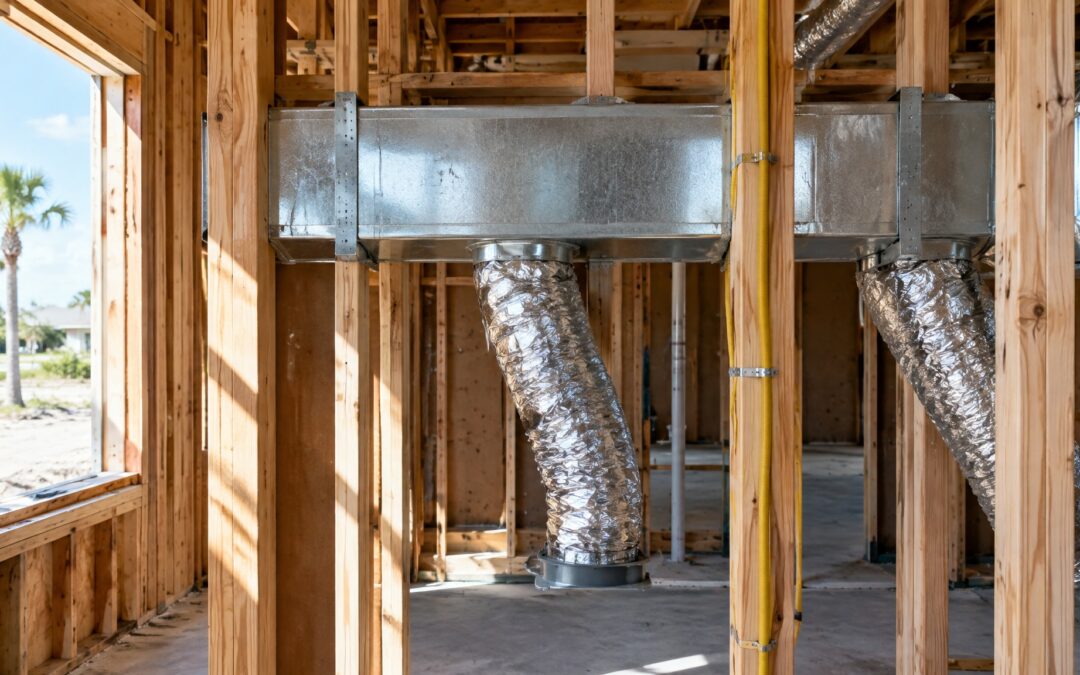
If you’re building in Southwest Florida, the AC is one of the biggest decisions in the house, and it usually gets made on a spec sheet you only skim. I’m writing this as part of the Infinite Electric & Air family. We’re a licensed electrical and HVAC contractor serving Fort Myers, Cape Coral, Naples, Estero, and the wider region, and Vinny, our founder, is a third-generation home services professional.
Here’s what I won’t do. I won’t print one dollar range and call it the AC installation cost for new construction in Florida, because a number with no scope behind it misleads people. What I can do is show you how the price is built, so any quote you hold becomes easier to read. If you’re after ductless pricing instead, that has its own guide on ductless installation pricing.
Why New Construction Changes AC Installation Cost
A new-build install is not a replacement job with the old unit missing. On a replacement, someone has to pull out the old equipment, work around ducts that are already in the ceiling, and live with whatever the original builder left behind.
On a new build, none of that tear-out exists. But the trade-off is timing.
Duct layout, electrical rough-in, and permit timing all get fixed while the house is still framing. That means the price of your system is effectively set earlier than most buyers expect, and the later you ask questions, the fewer easy answers there are.
Two kinds of readers land here, and you may be either one. You might be a buyer working through a builder’s spec sheet, trying to figure out what that one HVAC line really means. Or you might be an owner-builder choosing the system yourself, with nobody else’s package to lean on.
Either way, your leverage is greatest before the walls close. This article is for central systems only; if you’re still deciding between ducts and a ductless setup, start with our comparison of ductless versus central air in SWFL homes.
What Drives a Central Air Install Price in Southwest Florida
Four things do most of the work: how the system is sized, which equipment tier you choose, how well the outdoor unit and indoor coil are matched, and how much duct work the house needs. Equipment tier and duct scope usually open the widest gaps between two bids. Electrical work is often a smaller line, but it’s the one that surprises people late.
Sizing Starts With a Load Calculation
Sizing should come from a room-by-room load calculation built from the actual plans. The industry standard is the ACCA Manual J method, and it looks at orientation, window area, insulation, and air sealing.
A square-footage rule of thumb ignores all of that. Two 2,000-square-foot homes can need different tonnage, because one faces west with large glass and the other sits shaded with tight construction.
Oversize the system and it cools the air fast, shuts off, and never runs long enough to pull humidity out. Undersize it and it runs flat out on a July afternoon without catching up. When you compare quotes, the tonnage should match if both contractors sized from your plans, and if it doesn’t, ask each of them to show their work.
Equipment Tier, Efficiency, and Staging
Equipment comes in three broad tiers: single-stage, two-stage, and variable-speed. A single-stage unit runs at full output whenever it runs. A two-stage unit has a lower setting for mild days, and a variable-speed unit adjusts continuously, which tends to hold temperature and humidity steadier.
Efficiency works the same way, since a higher SEER2 rating costs more up front. In a place where the AC runs most of the year, that extra efficiency pays back faster than it would in a state with a real winter, so it deserves a hard look instead of a quick skip.
The match between outdoor unit and indoor coil matters just as much. A mismatched pair can’t deliver the rating printed on the box. A higher tier also won’t rescue a bad duct layout, so don’t spend on equipment before the sizing and the ducts are right.
What a New-Build AC Install Covers Beyond the Outdoor Unit
Homeowners picture a condenser sitting on a pad. The real job is a whole system, and each piece below belongs on your quote:
- Duct design and sealing. In Southwest Florida the ducts often run through a hot attic, so leaks and thin insulation waste cooled air before it reaches a room.
- Air handler and coil match. The indoor and outdoor parts have to be rated to work together.
- Line set length. The longer the run between indoor and outdoor equipment, the more it affects installation and performance.
- Condensate drain. Humid air produces a lot of water, and it needs a proper path out.
- Thermostat wiring. It’s cheap to run right during framing and annoying to fix afterward.
- Permit fees. These should be listed, not buried.
Electrical Scope: Circuit, Disconnect, and Panel Capacity
This is the part we know best, because electrical work is half of what we do. A central system needs a dedicated circuit, a disconnect near the outdoor unit, and a panel with room to carry the load.
You’d think a brand-new house would always have that covered. It doesn’t always, especially when the panel was sized for the original plan and the AC changed afterward. If you’re weighing the options, our guide to electrical panel upgrade costs explains what pushes that number up or down.
Builder-Grade AC Upgrades: What’s Worth Changing
“Builder grade” isn’t an insult. It means a basic system chosen mainly for cost, and it will cool the house. The question is whether it’s the right system for your house and your humidity.
What a Standard Builder Package Usually Includes
A standard package is typically a basic-tier unit sized to the builder’s usual plan, with ducts and a basic thermostat. What it leaves out is often the detail that matters: a documented load calculation, humidity control beyond what the equipment does by default, and any extra protection for the electrical side.
Read your contract for four things: the model, the tonnage, the efficiency rating, and whether a load calculation was done. A line reading “HVAC allowance” with a fixed dollar figure but no tonnage, efficiency rating, or model number is exactly the wording to question before you sign. An allowance tells you what the builder plans to spend, not what you’re getting.
Upgrades Worth Pricing for SWFL Humidity
In our climate, comfort is as much about moisture as temperature, so these upgrades are worth a real quote:
- Variable-speed or ECM air handling. It runs longer at lower speeds, which removes more humidity.
- Matched filtration. A filter sized to the air handler keeps the coil clean without choking airflow.
- Sealed and insulated ducts. In a hot attic, this is often the most valuable item on the list.
- A humidity-aware thermostat. It lets the system respond to moisture, not only temperature.
- Whole-home surge protection. Summer storms put real stress on a new compressor.
Most other add-ons are optional extras, mostly cosmetic. A fancy thermostat face or a premium-looking cover won’t change how the house feels. And none of these upgrades can fix a system that was sized wrong, so fix the sizing first.
How Florida Conditions Shape an AC Install in a New SWFL Home
Heat and humidity circle right back to sizing. A system that’s sized correctly for our long cooling season and heavy moisture load will run in steady cycles, and one that isn’t will either short-cycle or struggle. That’s why the load calculation matters so much here.
The outdoor unit also lives outside, facing weather your ductwork never sees.
Wind Anchoring, Flood Elevation, and Salt Air
Think of this as a checklist you can ask your installer about, not a list of worries:
- Wind anchoring. Is the outdoor unit strapped or anchored to its pad so it stays put in a storm?
- Raised pad. Where your flood zone or elevation plan calls for it, the unit should sit higher than the ground-level default.
- Corrosion-resistant coatings. On coastal lots in Cape Coral and Naples, salt air eats at coils and cabinets, so ask what protection the equipment has.
Requirements differ by lot and jurisdiction, so confirm what your permit office expects. Your builder or installer should be able to tell you, in plain words, which of these apply to your site.
How to Read a New Construction HVAC Quote
A price range only means something when its scope is written down. Two quotes that look $2,000 apart may simply cover different things, and you can’t tell without the details.
Line Items an Itemized Quote Should Show
When you’re lining up a new construction HVAC quote, check that each of these appears in writing:
- Exact efficiency rating and tonnage, plus the model numbers
- Refrigerant type
- Electrical scope: circuit, disconnect, panel capacity
- Duct scope, including sealing and insulation
- Who applies for the mechanical permit and who schedules the rough-in and final inspections
- Warranty terms, and who registers them
- Start date, with equipment lead time
If one quote leaves a line blank, ask about it before you compare totals. For the installer side, we put together a short guide on how to vet an HVAC contractor.
Lock the Spec Before Drywall and Inspections
The contract should also say when the HVAC rough-in must be complete relative to drywall. Those dates set the window where spec changes are still easy to make.
After the walls close, a change means opening drywall, rerouting ducts, or re-pulling wire. That’s slower and costlier than the same change made during framing.
Permitting practice varies between Lee County, Collier County, and Cape Coral, so confirm each office’s current process before you rely on any timeline.
Lifespan, Maintenance, and Choosing the Right Installer
Florida’s heat and humidity make a system work harder than it would in a milder state. Because it runs nearly year-round, it racks up run hours faster. So in our experience, sizing, install quality, and routine maintenance usually matter more than the name on the cabinet.
Early failures tend to trace back to the same few things: a refrigerant charge that was off from day one, a condensate drain that clogs, or loose electrical connections. All three come down to the installer’s care, not the brand.
I’ll be straight about a limit here. No installer can promise a number of years, and good work only improves your odds; it doesn’t cancel the climate.
Our 4.9 Google rating came from showing up on time and telling people the truth, even when it wasn’t the answer they hoped for. That’s how we try to lead, with love and honesty, in every house we work in.
If you have a new build coming in Southwest Florida, send me your plans and the builder’s HVAC spec. We’ll go through them line by line with you, no pressure and no pushy sales talk. Then let’s set up a call or site visit before the rough-in inspections, while changes are still easy. You can reach our local HVAC team in Estero to get that scheduled. Once the system is in, our AC maintenance plan keeps it running the way it should.
Frequently asked questions
What’s the average lifespan of an AC unit in Florida?
There’s no honest single number, because Florida’s near year-round cooling puts more run hours on a system than a milder climate does. A correctly sized, well-installed, regularly maintained system gives you the best odds of a long life. Early failures usually trace back to refrigerant charge, condensate drainage, or electrical connections rather than brand.
How much does it cost to add AC to a 2,000-square-foot house?
Square footage alone doesn’t set the price. Tonnage comes from a load calculation, and the total depends on equipment tier, duct scope, electrical work, and permits. Send us your plans and we’ll give you an itemized quote for your actual house.
What are common AC problems?
In our work the usual culprits are an incorrect refrigerant charge, a clogged condensate drain, and loose electrical connections. Leaky or uninsulated ducts in a hot attic also waste cooling. Most of these are installation issues, so getting the install right matters more than which brand you pick.
Does the brand matter more than the installer?
In Florida, usually not. A well-matched system that’s properly sized, sealed, and charged will outperform a premium brand installed carelessly. Judge the installer’s sizing method and written scope before you worry about the name on the unit.