
If you live in Cape Coral, Fort Myers, Naples or Estero, you know the rhythm of our summers. The sky turns dark around 3 p.m. the thunder rolls in off the Gulf, and the lights flicker once before they decide what to do.
I’m Vinny, and I’ve spent my life in home services, as did my father and grandfather before me. Over the years I’ve seen what a single bad spike can do to a refrigerator, an AC control board or a home office. This page explains how a whole-home surge protector works, what it can’t do, and how to plan the installation so it fits the rest of your electrical system.
Storm Electrical Protection for Southwest Florida Homes
Our storm pattern is not a once-a-year event. Afternoon thunderstorms and lightning run through the summer, and hurricane season stretches from June into late November. Outages follow the big storms, and so does the moment when the power comes back on.
A word on terms: in this article, “surge” means a spike in electrical voltage. It has nothing to do with storm surge, the flooding we all dread.
Here is the part most homeowners don’t expect. Many damaging surges never touch the house. A strike on a nearby pole, a transformer or a line down the street can push a spike along the power lines and into your service, even when the lightning lands blocks away.
That is why storm electrical protection starts at the panel, where everything on the property connects. It also explains why a house can lose an AC control board during a storm without a single scorch mark outside.
What a Whole-Home Surge Protector Does, and What It Cannot Do
A whole-home device is a good tool, but it has a specific job. Knowing the job keeps you from expecting too much of it, or too little.
Panel Surge Protection for Homes Across SWFL
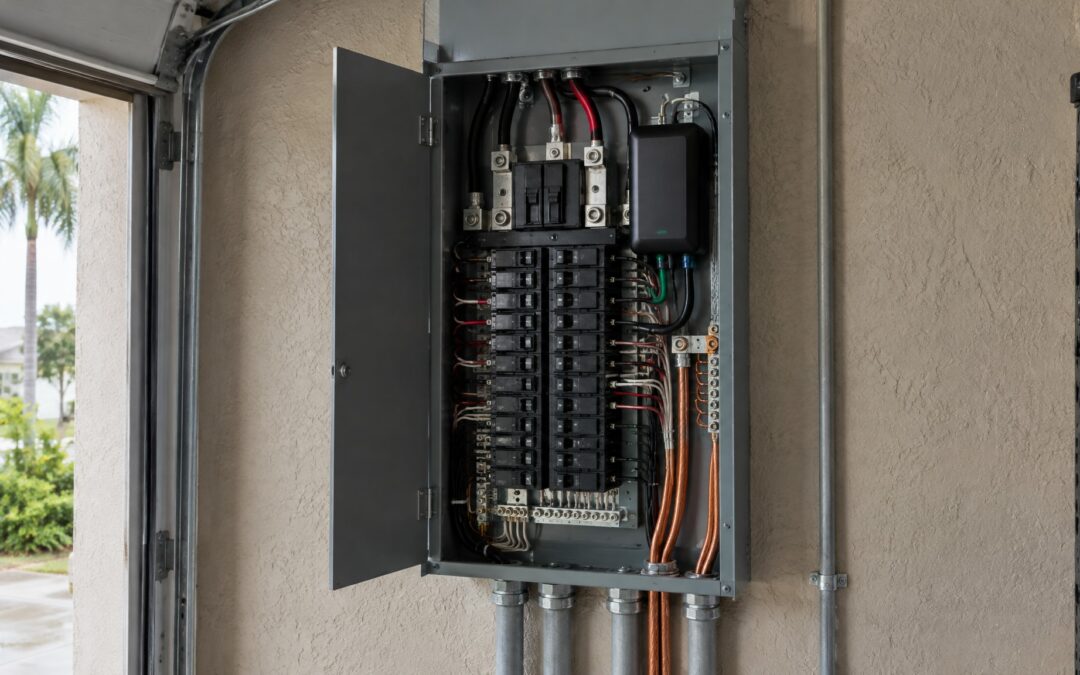
A whole-home surge protector mounts at or near your main electrical panel. Because the panel feeds your circuits, one installation guards everything fed from it, rather than a single outlet at a time. That is the main appeal of panel surge protection: you don’t have to remember which outlet has the good strip plugged into it.
In plain terms, it works like a pressure relief valve. When voltage jumps above a safe level, the device clamps the spike and diverts the excess to ground before it travels through your wiring.
Picture a typical July storm. Lightning hits near the neighborhood, and a spike runs down the service line. With a panel-mounted device in place, the excess is sent to ground before it reaches the refrigerator, the lights and the controls on your AC or mini-split. Those controls are among the loads the device helps guard, and they are expensive to replace in the middle of a Florida summer.
Where Its Limits Are: Direct Lightning Strikes and Sensitive Electronics
I’d rather tell you this up front than have you find out later: a whole-home surge protector cannot stop a direct lightning strike on your house. Nothing installed at the panel can do that, and anyone who promises it is selling you something.
It also doesn’t replace protection at the outlet. Computers, TVs, game systems and other sensitive electronics still benefit from point-of-use protection, because the panel device handles the big spike and a plug-in unit catches what’s left over.
Think of it as two layers. The panel device takes the heavy hit for the whole house, while the plug-in protectors look after the electronics you’d hate to lose. If you only want one, the panel is the better starting point, but this setup works best with both.
Why a Whole-Home Generator and a Surge Protector Belong Together
If you already own a generator, or you’re planning one, this section matters most. A generator is how you get through the outage. A surge protector helps your home survive the switching that surrounds it.
Generator Transfers and Power Restoration
Two moments in every outage involve switching. The first is when your home moves from utility power to generator power. The second is when the utility comes back and your home moves again. Line crews re-energize circuits, loads kick on all at once, and the electrical supply can bounce around before it settles.
Any of that switching can send voltage disturbances into your panel. A device mounted at the main panel sits right where those disturbances reach your home’s wiring, so it is the natural place to catch them.
So the two systems do different jobs. The generator keeps your power running, and the surge protector shields your wiring and appliances from the rough edges of the switch.
This doesn’t mean a generator without a surge device is unsafe. It means you’ve spent real money on backup power and left the most exposed point of your electrical system unguarded. For more on that side of the project, here is our guide to whole-home generator installation for storm season.
Planning Both Systems Before Storm Season
The smartest time to add a surge protector is when someone is already working in your panel. Both projects involve the same panel, the same breaker space and the same grounding. If you do them separately, an electrician opens the panel twice and checks the same things twice.
When you book, tell us whether a generator is planned. We can then look at panel capacity, breaker space and grounding once, and lay out the work so neither system gets in the way of the other.
If you’re budgeting for both, our breakdown of generator installation costs in Florida will help you see the generator side before the panel assessment gives you the rest.
One more point: it’s early November now, and hurricane season ends this month. That is the best moment to plan. Contractors are less rushed, and you can have the work done well before the 2027 season begins.
What Surge Protector Installation Looks Like in a Florida Home
Most people expect a whole house surge protector install to be disruptive. It isn’t, and a licensed technician handles every step. Here is the order the visit follows:
- On-site assessment. We look at your home, your panel and any storm or flicker problems you’ve had.
- Panel and breaker space check. We confirm the panel has room and is in good enough shape to take the device.
- Grounding and bonding check. We test the connection the device depends on.
- Permit, where required. If your area requires one for this work, we handle it.
- Mounting and connection. The device goes in at the panel.
- Walkthrough. We show you what was done and answer your questions before we leave.
Notice that the device is mounted only after the checks are finished. We don’t show up with a unit and bolt it on.
Panel and Grounding Check Before Anything Is Mounted
A surge protector is only as good as the grounding it connects to. The device diverts excess voltage to ground, so if that path is poor, the protection is poor too, even with a high-quality unit on the wall.
That’s why your electrician should check grounding and bonding at the panel first. In Southwest Florida, where sandy soil, humidity and older additions are common, it’s a check worth making rather than assuming.
If the panel and grounding pass, mounting is usually the shortest part of the day. If they don’t, you’ll hear about it before any work starts, and we’ll explain what we found in plain words.
Surge Protector Installation Cost in Southwest Florida: What Drives the Price
I won’t give you one number here, because a number printed on a web page can’t know your panel. What I can do is show you what moves the price, so the quote you get makes sense when it arrives.
The Factors That Set Your Quote
Several things shape the cost of surge protector installation in Florida:
- Panel size and condition. A newer, well-kept panel is straightforward. An older one takes more time.
- Available breaker space. Most devices need room in the panel to connect.
- The device chosen. Units differ, and we’ll go over the options with you.
- Grounding and bonding work. If the check turns up a weak connection, it has to be corrected.
- Permit requirements. These apply where they apply, and they can add a step.
- Panel access. A panel that is easy to reach is quicker to work on than one buried behind storage or in a tight spot.
Those six items are why two neighbors on the same street can get different quotes. The only way to get your exact price is an on-site assessment, and ours comes with no pressure to say yes.
When Panel Work Should Come Before the Surge Protector
I’ll be candid: an older or undersized panel may need work first. If the panel is full, worn or doesn’t have the capacity for what you’re adding, a surge protector on top of it just covers a bigger problem.
When the assessment shows that, I’ll tell you plainly, and I won’t push you toward the larger job if you don’t need it. Some homes only need a new breaker or two. Others do need a bigger panel, and it’s better to know that before storm season than after a failure.
To compare before you decide, see our guides to electrical panel upgrade costs in Florida and circuit breaker replacement costs in Florida. They cover what older or crowded breakers can mean for the work that comes before the device.
Why a Licensed Electrician Matters for Surge Protection in Florida
Working inside a main panel is not a weekend project. The panel is live from the utility side even with the main breaker off, and a mistake there can hurt someone or start a fire. If a permit is required, it also needs to be pulled and inspected properly.
That’s why I keep this work with licensed electricians. If you want the longer version, here is why licensed electricians matter for panel work.
Infinite Electric & Air is a licensed electrical and HVAC contractor, and I’m a third-generation home services professional. My family taught me that the job isn’t done when the tool goes back in the truck. It’s done when you trust what we told you. We try to lead with love in everything we do, and in practice that means showing up on time, telling the truth about what your home needs, and not selling you more than that. Our 4.9 Google rating comes from neighbors who’ve seen it firsthand.
I also want to be precise about one thing. A whole-home surge device is not a lightning rod system. If you’re searching for a lightning protection electrician in Florida, understand that we install protection at your panel, which guards your wiring and appliances from spikes that travel over the lines. We do not install lightning rod systems on the roof.
Schedule Your Whole-Home Surge Protector Installation
Storm season ended up on your calendar long before you read this page, and 2027 will be no different. The best time to get ready is before the first June thunderstorm.
When you call, have a few things handy:
- Where your main panel is located
- Any recent flickering lights, tripped breakers or outage problems
- Whether you’re planning a generator
That’s enough for us to get started. From there, we’ll set up a licensed on-site check of your panel, breaker space and grounding, give you an honest recommendation, and put an exact quote in writing. If you decide not to move ahead, that’s fine with us.
You can call or request an appointment through our page for trusted local electrical services in Fort Myers. If storm damage or an outage is happening right now, go straight to our emergency electrician in Naples page instead.
Frequently asked questions
Will a whole-home surge protector stop lightning from damaging my house?
No. It protects against voltage spikes that travel in over the power lines, including from strikes that land nearby. It cannot stop a direct lightning strike on your home, and it is not a lightning rod system.
Do I still need plug-in surge protectors if I install one at my panel?
Yes, for sensitive electronics like computers and TVs. The panel device handles the large spike for the whole house, and point-of-use protectors give those devices a second layer.
How much does surge protector installation cost in Southwest Florida?
The price depends on panel size and condition, available breaker space, the device chosen, grounding and bonding work, permit requirements and panel access. Because those vary from house to house, we give an exact quote after an on-site assessment instead of a single figure.
Can I install a whole-home surge protector myself?
We don’t recommend it. The device connects inside your main panel and depends on correct grounding and bonding, and that work belongs with a licensed electrician. Where a permit is required, it must be handled properly too.
If I’m getting a generator, should I add a surge protector at the same time?
Yes, it’s usually the smartest way to do it. Generator transfers and power restoration both involve switching that can send voltage disturbances into your panel, and planning both together means the panel work isn’t repeated.