
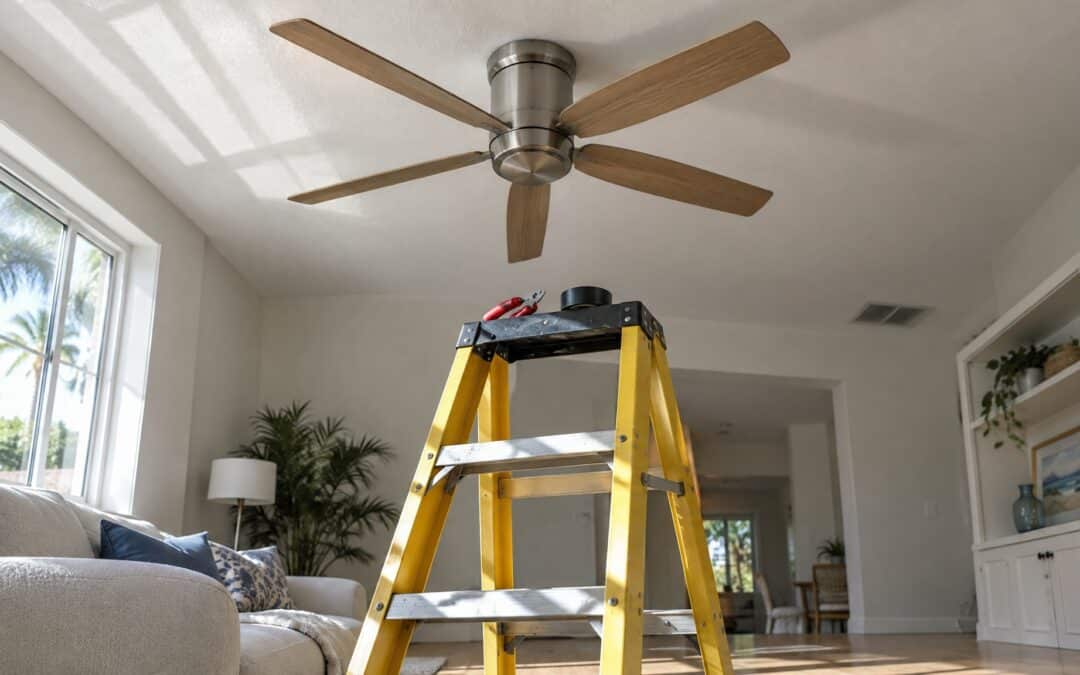
When a ceiling fan wobbles, hums, or quits, most people call whoever is cheapest and closest. I understand that. But a fan hangs over your family’s heads, and it connects to the wiring inside your ceiling, so I think it deserves a licensed hand.
I’m Vinny, and I started Infinite Electric & Air because I grew up in a third-generation home services family. My grandfather and my father taught me that the job isn’t done when the tool is put away. It’s done when the customer feels looked after. That’s why we lead with love, and it’s why this page exists: to explain what good ceiling fan installation in Fort Myers looks like, so you know what to expect before anyone comes to your door.
We’re a licensed electrical and HVAC contractor, and our neighbors have given us a 4.9 Google rating. We’re proud of that, and we work to keep it.
Why a Licensed Electrician Is the Right Call for Your Ceiling Fan
A fan looks like a small job, and often it is. The part people miss is that the work happens in the ceiling, where the fan’s weight, its motion, and your home’s circuit all meet.
Licensed Electrician vs. Handyman for Fan Work
A handyman can be a good person with good hands. I’ve worked alongside plenty of them. The difference is what stands behind the work, because a licensed electrical contractor answers to a licensing board, carries code training, and has to stand behind the wiring after we leave.
If something goes wrong with a handyman’s connection, you may have nowhere to turn but the person who did it. With a licensed contractor, there is a record, a rulebook, and a business whose name is on the line.
That doesn’t mean a handyman is a bad choice for painting a fence or hanging a shelf. It means wiring is the wrong place to save a little money and hope for the best. If you want the fuller comparison, here is our guide on licensed electrician vs. handyman work in Florida.
Before you book anyone, check the license yourself. Florida runs a public license search through the Department of Business and Professional Regulation, and it takes a couple of minutes. Look up the contractor’s name or business, confirm the license is active, and make sure it’s an electrical license, not just a general one.
Permits, Code Checks, and Accountability
Some fan jobs, like a simple swap on an existing, fan-rated box, may not need a permit. Others, like new wiring or a new circuit, can. Rules differ between Lee County, Cape Coral, Fort Myers, and Collier County, so your electrician should know which applies to your address.
That’s what permit responsibility means for you. The contractor pulls the permit, answers for the work, and makes sure it passes inspection where one is required. You don’t have to learn the code, and you aren’t left holding a problem that was never checked.
Insurance companies also care how electrical work was done. A job done properly and documented is one less thing to worry about if you ever file a claim.
Ceiling Fan Wiring for SWFL Homes: What a Safe Install Requires
Southwest Florida is hard on fans. They run nearly year-round, the air is humid, and many homes carry wiring that was never planned for the way we live now. Good ceiling fan wiring in SWFL starts with the part nobody sees.
Fan-Rated Boxes and Secure Mounting
A light fixture hangs still and carries a few pounds. A fan carries more weight, and it also moves, pulling and twisting on its mount every second it runs. That’s why the box must be rated for a fan and fastened to the building’s structure, not just to the drywall or a thin bracket.
A standard light-fixture box isn’t built for that load. It may hold for a week or a month, then loosen, wobble, and eventually let go. Nobody wants to find that out at 2 a.m. with a bedroom fan spinning overhead.
So before anything goes up, we look at what’s in your ceiling. If the box isn’t fan-rated, we replace it with one that is and secure it properly. Sometimes that means adding support between joists, which is why we’d rather look in the attic or at the ceiling than guess.
We also check for older wiring. Some homes have no neutral wire at the ceiling box, and certain wall controls and smart receivers need one. A licensed electrician finds that out before the fan is mounted, not after, so your plan fits what your home can actually support.
One limit worth knowing: a fan install can’t fix a panel that is already maxed out. If a new circuit is part of the plan and your panel has no room, you’ll want to read about the signs your electrical panel needs an upgrade so you aren’t surprised.
Damp and Wet Ratings for Lanais and Covered Porches
Where the fan hangs matters as much as how. Fans carry listings for dry, damp, or wet locations, and the right one depends on how much weather reaches it.
- Indoor rooms: a standard fan is fine in bedrooms, living rooms, and kitchens.
- Screened lanais and covered porches: these are usually damp locations, so you want a damp-rated fan.
- Fully exposed spaces: if rain or spray can reach the fan, such as an open pergola or an uncovered patio, you need a wet-rated fan.
Salt air adds one more wrinkle. If you live near the Gulf, the Caloosahatchee, or a canal in Cape Coral, corrosion-resistant hardware is worth choosing. Cheap screws and fittings rust fast near the water, and a fan that rusts will start to wobble well before the motor wears out.
If you aren’t sure which category your porch falls into, tell us what it looks like. A photo helps, and we’ll steer you toward a fan that fits the space and your budget.
What a Ceiling Fan Installation in Fort Myers Includes
Nobody wants strangers wandering the house with no explanation. So here is what a typical visit looks like, and you’re welcome to ask questions at any point.
Installation Day, Step by Step
- Confirm the fan and the box. We check that the fan you chose suits the room, and that the box overhead is fan-rated and secured to the structure.
- Shut off and test the power. We turn off the breaker, then test the wires to make sure they’re dead. We never trust a switch alone.
- Mount and wire. The bracket goes up, the fan is hung, and the connections are made and tucked neatly into the canopy.
- Balance the blades. A fan that’s out of balance wobbles and wears out its mount, so we take the time to get it smooth.
- Test speed and light. Every speed setting and every bulb gets checked before we call it done.
- Set up controls. If you want a wall control, a remote, or a smart control, we wire it and show you how it works.
- Clean up. We leave your space the way we found it, minus the old fan and packaging.
High or vaulted ceilings are common in Southwest Florida homes, and a fan hung from one may need a longer downrod so the blades sit at a comfortable height and move air where you actually are. We account for that in the quote up front, so it never shows up as a surprise on the final bill.
Most visits don’t need much more of your time than being home to let us in and answer a few questions.
Ceiling Fan Install Cost in Florida: What Drives the Price
I won’t throw a number at you here, because the honest answer is that two fan installs on the same street can cost very different amounts. What changes the price is what’s in the ceiling and what you want the fan to do.
Swap-Out Jobs vs. New Wiring or a New Circuit
The simplest job is replacing an existing fan, or a light, on a box that’s already fan-rated and wired. The power is there, the support is there, and the work is mostly mounting and connecting. That costs far less than the alternatives.
Things get more involved when your ceiling has no wiring for a fan at all. Running new cable through an attic or finished ceiling takes more time and skill. Moving a fan to a new spot, or adding a dedicated circuit, takes more again.
When a new circuit is the reason for a higher quote, it helps to understand what breakers and panel work involve. Our overview of circuit breaker replacement costs in Florida explains what’s behind those numbers.
Extras and Site Conditions That Change the Quote
A few other things move the price, and none of them are hidden:
- Smart controls or wall controls that need extra wiring
- Light kits and dimmers
- Long downrods for high ceilings, and the ladder or scaffold access that goes with them
- Damp- or wet-rated fans, which can cost more than a basic indoor model
- Repairs we find along the way, like a damaged box or old wiring
You’ll get an itemized quote, in plain words, so you can see what each part costs and decide what to keep. If a cheaper option works just as well for your ceiling, we’ll say so. We’d rather earn a customer for the next twenty years than squeeze one job.
Energy Savings: Letting a Ceiling Fan Share the Cooling Load
A ceiling fan doesn’t actually make the room colder. It moves air across your skin, which helps sweat evaporate, and that’s why you feel cooler even though the thermometer hasn’t budged.
That detail is useful. If the fan makes you comfortable, you can often set the thermostat a degree or two higher and still feel fine, which gives your AC a bit less to do. Fans only help the people in the room, though, so turn them off when you leave.
A fan also won’t replace your air conditioner in a Florida summer. Think of it as a partner to the AC, not a substitute.
Winter helps too. Most fans have a switch that reverses the blades, and running them slowly in reverse nudges warm air down from the ceiling on those cool Southwest Florida mornings.
Your fan and your AC work best when both are in good shape, so a AC maintenance plan in Fort Myers is a natural companion to a new fan.
Quick Scheduling for Ceiling Fan Installs in Cape Coral and Fort Myers
When your fan is dead and it’s 90 degrees outside, you don’t want to wait weeks for a call back. We built our service around fast response, and when the calendar allows, we can often get to you the same day. You can read more about same-day electrician visits in Fort Myers and how to request one.
We serve Fort Myers, Cape Coral, Naples, Estero, and the surrounding Southwest Florida area. If you’re in Cape Coral, our page on ceiling fan installation in Cape Coral is the best place to start, and it covers what’s specific to homes there.
Finding a Ceiling Fan Electrician Near You
Searching for a ceiling fan electrician near me usually turns up a long list of names, and it’s hard to tell who’s worth a phone call. Do what your neighbors do: read the reviews, ask who they used, and check the license.
Whether you need to install a ceiling fan in Cape Coral, hang one on a Fort Myers lanai, or replace an old fan in Naples, the process is the same. You tell us what you’ve got, we tell you honestly what it takes, and we show up when we said we would.
Estero homeowners can find an electrician near you in Estero through that page, which is built for local searches like yours.
Booking Your Fort Myers Ceiling Fan Installation
Call us or send a request for a visit, and we’ll find the soonest time that works for you. There’s no pressure and no hard sell, just a straight conversation about what you need.
It helps to have a few things ready when you reach out:
- The fan style you want, or a link to the one you’re considering
- The ceiling height in that room
- A photo or two of the spot on the ceiling where the fan will go
With those, we can usually give you a clear, honest quote and a sense of timing right away. If you don’t have a fan picked out yet, that’s fine. We’ll help you choose one that suits the room.
Reach out to Infinite Electric & Air today to schedule your ceiling fan installation in Fort Myers. A licensed electrician is a call away, and we’d be honored to take care of your home.
Frequently asked questions
Do I need a permit to install a ceiling fan in Florida?
It depends on the job and your local jurisdiction. A simple swap onto an existing fan-rated box often doesn’t need one, while new wiring or a new circuit can. A licensed electrician will tell you which applies at your address and handle the permit if one is required.
Can I use my existing light fixture box for a ceiling fan?
Only if it’s rated for a fan and secured to the structure. A standard light-fixture box isn’t built to carry a fan’s weight and constant motion, so it can loosen over time. We check the box first and replace it when needed.
Which fan do I need for a screened lanai or covered porch?
A damp-rated fan is the usual choice for a screened lanai or covered porch. If rain or spray can reach the fan directly, you need a wet-rated one. Near the coast, corrosion-resistant hardware is also a smart pick.
Does a ceiling fan really lower my air conditioning use?
A fan makes you feel cooler by moving air across your skin, not by lowering the room’s temperature. That means you can often raise the thermostat a little and stay comfortable. It only helps while people are in the room, and it doesn’t replace your AC.
What should I have ready when I call to book?
Know the fan style you want, the ceiling height, and have a photo of the ceiling spot where it will go. That lets us give you a clear quote and plan for things like a longer downrod. If you haven’t chosen a fan yet, we can help you pick one.