
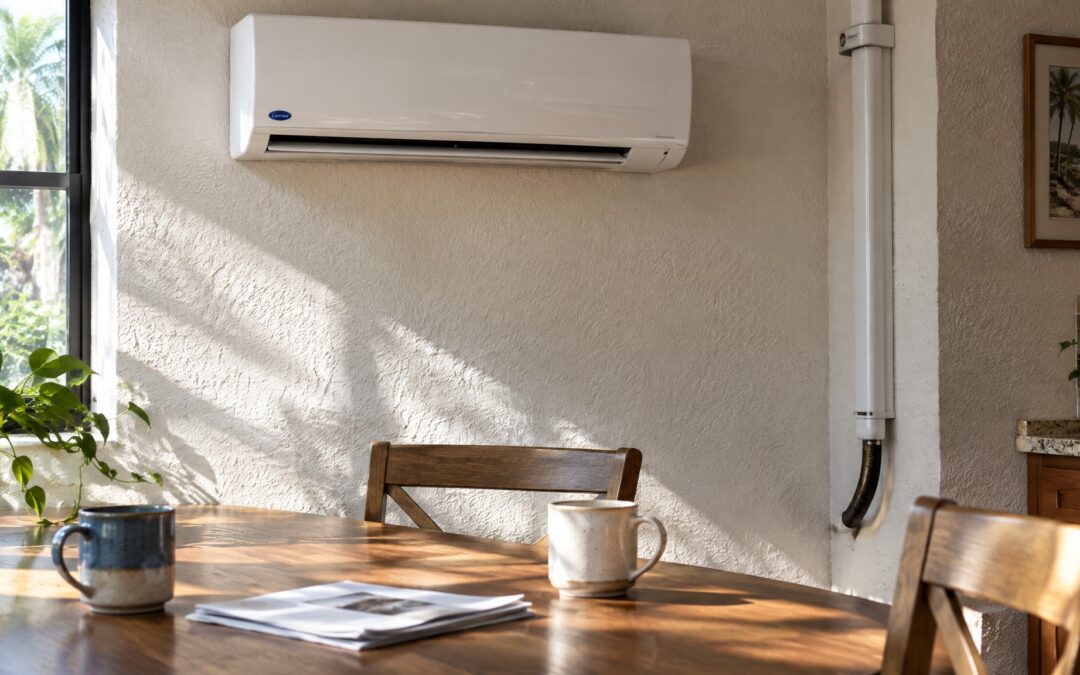
Every few weeks a homeowner in Fort Myers or Cape Coral asks us the same thing at the kitchen table: “Carrier or Trane? Just tell me which one.” We understand the question. A mini split is a big purchase, and you want somebody honest to point the way.
So here is our honest take, from a crew that installs and services these systems in Southwest Florida heat. We lead with love in this work, and that starts with telling you the truth, even when the truth is “it depends.”
Carrier vs Trane Mini Splits: The Short Answer for Florida Homes
Neither brand is a poor choice for a Southwest Florida home. Both are established names with long track records and wide dealer networks, and the better pick for you depends on the exact model, the sizing, and the installer who will service it.
That means the nameplate decides less than most people expect. A correctly sized system, installed carefully by a contractor who stays local and answers the phone, will outperform a famous brand installed in a hurry.
If two quotes look equal on equipment and scope, give the job to the installer who explains how the system handles humidity in plain words. Someone who can do that has usually watched these systems run through a Florida summer.
One thing we won’t do is pretend mini splits are perfect. The real downsides here are the upfront cost per zone, indoor heads that stay visible on your wall, and drain, filter, and coil upkeep that cannot be skipped. If you want zero maintenance and nothing on the wall, a mini split is not the right fit for you.
If you haven’t settled on a system type yet, start with our guide to ductless vs. central air for SWFL homes. This article assumes you’ve chosen ductless and are deciding on a brand.
Comparing Mini Split Brands Against Florida Humidity
Here on the Gulf side, a large share of cooling is moisture removal. A unit that is too big cools the air quickly, shuts off before it dries the room, and leaves it clammy, so sizing shapes comfort more than the logo on the outdoor unit.
So don’t judge a brand by its name. Judge the exact model by how it runs at low output and how well it dehumidifies, because that is where your comfort gets decided from May through October.
Dehumidification and Run Time: What to Ask Before You Buy
A good mini split in our climate runs long and steady at low speed instead of blasting and stopping. That slow, continuous run is what pulls moisture off the coil and out through the drain.
Ask each dealer these things about the specific model on your quote:
- How low does the compressor modulate, and does the unit keep running at that low level when the room is nearly at setpoint?
- Does it offer a dry or dehumidify mode, and what does that mode do to fan speed and temperature?
- Does the remote or app let you control fan speed, or does the unit pick for you?
Ask for the answers from the manual or spec sheet, not from memory. Then ask how the installer would size the unit for your room, because the best model in the world dehumidifies poorly when it’s too large.
A dehumidify mode is not a cure for a wrong-size system. It helps at the margins, and that’s all.
Salt Air, Storm Season, and Outdoor Unit Placement
Salt air along the coast and storm-driven rain both shape where an outdoor unit should sit. An elevated mount, clearance from salt spray and standing water, and a secured base protect the unit whichever brand it is.
If you live near the water in Naples, Estero, or the Cape, ask whether the model offers a corrosion-resistant coil option. Not every line does, and it’s worth knowing before you sign, not after the first rusty season.
Placement matters just as much as coating. We look for a spot that stays clear of direct spray and sits above where water collects during heavy rain and flooding. We also look for a base that is strapped or anchored for wind. Check clearances and mounting height against the installation manual for your exact model, because requirements differ.
An Installer’s Honest Take on Carrier and Trane Mini Splits
We don’t have lab results or head-to-head durability data, and we won’t invent a ranking to make this article feel more decisive. What we can give you is a fair read on each brand and a list of what to verify.
You’ll hear two claims around town: Trane leads on humidity control, and Carrier leads on parts access. Treat both as hypotheses. The sensible move is to ask any dealer, us included, what their own service history says about the exact model you’re considering.
Carrier Ductless Review: Strengths, Trade-offs, and What to Verify
What it has going for it. Carrier has a long track record and a wide dealer network, which tends to mean you can find someone to service it when you need help. For many homeowners, that comfort of knowing help is nearby counts for a lot.
Trade-offs. Wide availability means installer quality varies from one dealer to the next, and the brand can’t fix that for you. Carrier also sells several ductless lines, so a glowing review of one model may say little about another.
What to verify. Confirm the controls (remote, wall control, or app) and whether you’d actually use them. Ask how the dealer sources parts for the exact model, and what the warranty requires, such as registration or a qualified installer.
Trane Mini Split Reviews: Strengths, Trade-offs, and What to Verify
What it has going for it. Trane also has a long track record and a broad dealer network. Plenty of homeowners trust the name, and many dealers across Southwest Florida know the equipment well.
Trade-offs. The same caveat applies: the logo doesn’t install itself. The reputation for humidity control is something to confirm on the model you’re quoted, not assume from the brand.
What to verify. Ask about controls, how parts are ordered after a storm, and what the warranty requires. Terms differ by product line, so get them for your model and your dealer.
Both of these reviews end in the same place, and that’s no accident.
Installation Quality Matters More Than the Brand Name in Florida
Two installs of the same brand can perform very differently. That’s why we tell homeowners to make sizing method and electrical scope the first questions they ask any dealer, before brand, before price.
Here’s a typical call. A homeowner tells us the thermostat says the room is cool, yet it feels sticky and the air smells a little musty. The system cycles on and off often, and the room never quite dries out. Nine times out of ten we find a unit that is too big for the space. The fix starts with sizing the room properly, not with swapping the brand.
Sizing First: Why an Oversized Unit Leaves Florida Rooms Clammy
An oversized unit hits the temperature target fast and shuts off. Because it never runs long enough, it never pulls out the moisture. You end up with a cold, damp room, and the fix is a smaller unit.
Ask the installer how they size. A good answer covers the room’s square footage and ceiling height, but also the sun exposure, windows, insulation, and what the space is used for. “We just match the old unit” or “bigger is safer” are red flags. Bigger is not safer here; it’s clammier.
Line Sets, Drain Lines, and the Electrical Circuit
Three details separate a good install from a callback. The line set (the copper refrigerant lines) should be sized and run correctly, with neat insulation and a clean path. The drain line needs a steady slope and a clear termination so condensate leaves the house without backing up. And the electrical circuit has to match the unit’s requirements.
That last part gets skipped more than it should. A mini split needs the right breaker, wire, and a disconnect at the outdoor unit, and why the electrical side needs a licensed electrician is something we take seriously. We’re licensed in both electrical and HVAC work, so the breaker, disconnect, and outdoor unit can be handled under one contractor.
If you want to see what that looks like start to finish, here’s our page on mini split installation in Fort Myers.
Reliable AC Brand in SWFL: What Parts, Service, and Warranty Tell You
Reliability here isn’t just about whether a unit runs well in July. It’s about how quickly parts can be sourced after a storm, and whether you’ll get someone qualified to fix it when you need them.
Owner reviews help most for spotting patterns: noise, drainage trouble, and slow parts orders. The installer’s follow-through tends to show up in those patterns more than the brand name does. Don’t use reviews to crown a winner, and verify any review wording before you trust it.
When you read reviews, ask yourself whether the complaints point at the product or at the install. A pile of drain leaks usually means a slope or termination problem, not a bad brand.
Warranty Terms and Parts Access Before You Sign
Warranty terms differ by product line, and coverage can depend on registration or a qualified installer. Have the dealer confirm both for the exact model, in writing, before you commit.
Ask these before signing:
- Who registers the unit, and by what deadline?
- Does coverage require a licensed or factory-qualified installer?
- Where do parts come from, and how does the dealer get them after a storm?
An installer who answers these without hesitating is telling you something good about how they work. If you want a checklist for the whole conversation, read our notes on how to vet an HVAC contractor.
Maintenance That Keeps Either Brand Running Well in Florida Humidity
In coastal humidity, drain lines, filters, and outdoor coils drive most of the upkeep, whichever brand is on your wall. Skip them and even a premium unit starts to smell, drip, or lose efficiency within a season or two.
Filters, Drain Lines, and Outdoor Coil Care
Filters. Pull the indoor filters, rinse or replace them as your manual directs, and let them dry fully before they go back in. A clogged filter cuts airflow and makes the coil sweat more than it should.
Drain lines. Algae and slime love a warm, wet drain. Watch for water dripping from the indoor head or a musty smell, because those are early signs of a partial clog. Have the line flushed before it overflows onto your wall or floor.
Outdoor coils. Salt, pollen, and yard debris build up on the coil. Keep plants trimmed back from the unit, and have the coil cleaned gently. Don’t blast it with a pressure washer, which can bend the fins.
You can do the filters yourself. The drain and coil work is easier with a technician who knows the model.
If you’d rather have it on the calendar, we offer an AC maintenance plan for Fort Myers homes. It’s an option, not a requirement, and your warranty and your system’s upkeep are things we’ll talk through honestly either way.
Comparing Quotes: Price, Scope, and Your Next Step
Is Carrier cheaper than Trane? The honest answer is that quotes vary by product line, dealer, and scope, so a brand-level price gap on its own isn’t reliable. A quote for one line can come in higher or lower than a quote for another, and it flips depending on the model.
Quotes compare fairly only when the equipment, the electrical work, and the line-set length match. One bid might include a new circuit and a short line run, while another quietly leaves out the electrical and assumes a longer run later. Put them side by side and make them match before you weigh price.
For a clearer picture of the pieces, see what mini split installation costs in SWFL.
If you’re in Fort Myers, Cape Coral, Naples, or Estero, we’d be glad to come out for an in-home assessment. We’ll check your room sizing, the electrical scope, and which brand and model actually fit your home. There’s no pressure and no pushy sales pitch, just an honest conversation from neighbors who want you comfortable. Call us or send a request online whenever you’re ready.
Frequently asked questions
Who makes the best mini split air conditioning?
There isn’t one best maker for every home. Carrier and Trane are both established, and the right pick depends on the exact model, correct sizing for each room, and an installer who will stand behind the work. In Southwest Florida, ask how a model runs at low output and dehumidifies before you compare brands.
What is the downside of having a heat pump?
Most mini splits are heat pumps, and the real downsides in Florida are the upfront cost per zone, indoor heads that stay visible on the wall, and upkeep you can’t skip. Filters, drain lines, and outdoor coils all need regular attention in humid, salty air. If you want nothing on the wall and no maintenance, it may not suit you.
Are Daikin and Carrier the same?
No. They are separate companies, each with its own ductless lines, parts, and warranty terms. Don’t assume what’s true for one applies to the other; ask the dealer to confirm controls, parts access, and warranty for the exact model on your quote.
Is Carrier cheaper than Trane?
Not reliably. Quotes vary by product line, dealer, and scope, so a brand-level gap tells you little. Compare bids only when the equipment, electrical work, and line-set length match.