
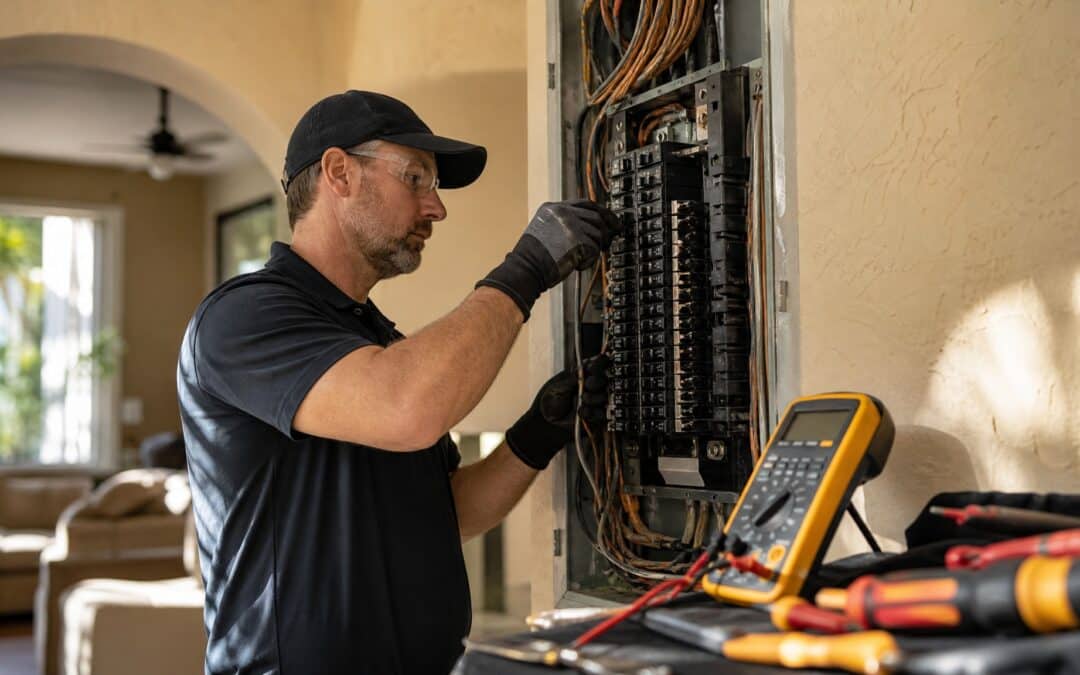
Buying a home in Southwest Florida is exciting. But the region’s climate and aging housing stock hide electrical risks that a standard walkthrough often misses. You might fall in love with a renovated kitchen in Cape Coral or a waterfront view in Naples, only to find out after closing that the wiring behind those fresh walls can’t handle your modern appliances. A dedicated electrical inspection before buying a house in Florida gives you the technical clarity to negotiate with confidence, or to budget accurately for the upgrades you’ll need.
This kind of evaluation goes well beyond what a general home inspector covers in a standard two-hour visit. We look past surface aesthetics and ask whether the home’s electrical system can actually support your family’s safety and comfort for years to come.
Why SWFL Home Buyers Need a Dedicated Electrical Inspection
Florida law doesn’t require a separate electrical inspection during a real estate transaction. That leaves many buyers assuming their general home inspection already covers this critical system. It usually doesn’t, and in older Cape Coral and Fort Myers homes, that assumption can mean inheriting hazards left behind by unpermitted DIY work or deferred maintenance. A specialized electrical inspection before buying a house in Florida checks safety for modern loads and storm resilience, not just whether the lights turn on during a brief walkthrough.
You deserve to know exactly what you’re buying before you sign the closing documents. General inspectors are trained to spot obvious visual defects across all home systems, but they don’t carry the licensing or diagnostic tools to evaluate circuit capacity, panel integrity, or code compliance in any depth. That gap matters here, because salt air accelerates corrosion along our coast, and decades of hurricanes mean many properties have taken repeated power surges or flood damage that quietly compromised internal components.
Older neighborhoods bring their own challenges. Homes built during the mid-century boom often still have aluminum wiring or outdated Federal Pacific panels. Both carry documented fire risks, yet both can still pass a superficial check and look fine doing it. Catching these issues during your due diligence period gives you leverage: you can request repairs, negotiate credits, or walk away from a money pit before it becomes your problem.
4-Point Inspection vs. Full Home Buyer Electrical Inspection in Florida
Many buyers confuse insurance-driven evaluations with real safety assessments, since both involve looking at major home systems. Homes 20 years or older often need a 4-point inspection for insurance eligibility, but that review exists to satisfy underwriters worried about liability, not to protect your long-term interests as a homeowner.
A 4-point inspection covers HVAC, plumbing, roofing, and electrical at a high level, just enough to confirm basic function and estimate remaining lifespan. It doesn’t test individual outlets, verify proper grounding, check branch circuit loading, or ask whether the panel can handle an EV charger, pool equipment, or whatever else you’re planning to add. A typical 4-point inspection runs $150, while a full home inspection averages $449 without discounts. Neither one includes the detailed electrical diagnostics that uncover hidden safety hazards.
A pre-purchase electrical inspection serves a different purpose entirely than satisfying an insurance carrier’s checklist. We evaluate the whole distribution system, from the service entrance to the last outlet, and flag code violations, capacity limits, and deterioration that a generalist isn’t equipped to find. This matters because insurance approval doesn’t equal safety. A home can be fully insurable and still harbor conditions that threaten your family, or cost you tens of thousands in repairs within months of moving in.
Understanding this distinction saves you from expensive surprises after you take ownership. If you’re wondering what it might cost to bring an older system up to current standards, our breakdown of electrical panel upgrade costs gives you a sense of what a deeper inspection might turn up.
What Our Pre-Purchase Electrical Inspection Covers
We approach every home buyer electrical inspection in Florida like our own family is moving into the property. That means testing every accessible outlet, verifying proper breaker sizing, and checking main panels for recalled brands or salt-air corrosion that could fail during peak summer demand or the next tropical storm.
Panel and Service Evaluation
The electrical panel is the heart of your home’s power distribution, which makes its condition the single biggest factor in overall system safety and capacity. We check for recalled manufacturers like Zinsco or Federal Pacific, whose breakers are known to fail to trip during overloads, creating fire hazards you’d never see behind a closed panel door. Decades of humid, salty air corrode connections and bus bars even when the exterior paint still looks fresh. So we look inside, at oxidation, heat damage, and the unpermitted modifications previous owners sometimes leave behind.
Service capacity tells you whether the home can actually support your lifestyle without constant tripping or dangerous overheating. Many older Southwest Florida homes were wired for 60 or 100 amp service back when families owned a fraction of today’s electronics. Central air, electric ranges, and charging stations now routinely call for 200 amps minimum. Finding insufficient capacity during inspection lets you budget for it or negotiate seller concessions, instead of discovering the problem during your first August heat wave.
Wiring Integrity and Code Compliance
Branch circuit wiring degrades over time, and coastal humidity and temperature swings stress insulation and connections faster than they would inland. We check for aluminum wiring in older neighborhoods, which expands and contracts differently than copper and loosens connections enough to arc inside walls, often without tripping a breaker. Builders installed this material widely during the 1960s and 1970s, and it’s still sitting behind the walls of plenty of Cape Coral and Fort Myers homes that look updated on the surface.
Modern safety codes exist because past practices proved deadly. We verify AFCI and GFCI protection meets current standards throughout the home. Ground fault protection saves lives in wet areas like kitchens, bathrooms, and garages. Arc fault breakers prevent fires caused by damaged cords or deteriorating insulation inside bedroom and living area walls. A general inspector can note a missing device visually, but can’t functionally test it without specialized equipment, and a missing or malfunctioning device is an immediate hazard either way.
If you notice intermittent dimming or buzzing during your initial walkthroughs, our flickering lights safety guide explains what those warning signs usually mean. These clues often point to deeper wiring problems worth a professional look before you commit to the purchase.
Honest Assessment Without Sales Pressure
Infinite Electric & Air founder Vinny brings third-generation trade expertise to every inspection, catching issues general inspectors miss in SWFL’s coastal environment. His family has served this community for decades, and he knows your goal is an informed decision, not a reason for us to generate repair work. Our team maintains a 4.9 Google rating by giving honest assessments instead of upselling unnecessary repairs during buyer inspections, because trust matters more to us than short-term profit.
A pre-purchase electrical inspection doesn’t guarantee a flawless system, and it won’t eliminate every future maintenance need in any Southwest Florida property. Older homes carry some inherent uncertainty no matter how thoroughly we check them, and even new construction can hide installation errors that only show up years later. What we give you is the clearest picture we can of current conditions and foreseeable risks, so you can move forward with confidence or point your search toward a safer investment.
When you’re ready to get answers specific to the home you’re considering, schedule your pre-purchase electrical inspection and let us help protect your family’s future. Why homeowners trust our licensed team comes down to treating every property like it belongs to someone we love, because in this community, it probably does.
Frequently Asked Questions
Should I get an electrical inspection before buying a house?
Yes, especially in Southwest Florida where aging homes, salt air corrosion, and unpermitted renovations create hidden electrical hazards that general home inspectors cannot fully evaluate. A dedicated electrical inspection identifies safety risks, code violations, and capacity limitations that could cost tens of thousands to fix after closing. The upfront investment gives you negotiation leverage and peace of mind that the home can safely support your modern lifestyle.
What will fail an electrical inspection?
Common failures include recalled Federal Pacific or Zinsco panels, aluminum wiring without proper remediation, missing GFCI/AFCI protection, overloaded circuits, and corroded connections from coastal humidity. Unpermitted additions, double-tapped breakers, and undersized service for modern loads also trigger red flags during professional evaluations. Each issue represents either an immediate safety hazard or a significant upgrade expense that affects the home’s true value.
What is the biggest red flag in a home inspection?
For electrical systems specifically, recalled breaker panels and active aluminum wiring pose the greatest immediate danger because they can cause fires without showing visible warning signs. Beyond electrical concerns, structural foundation issues, extensive mold, and unpermitted major renovations rank among the most serious discoveries. Any finding that threatens occupant safety or requires five-figure remediation deserves careful consideration before proceeding with purchase.
Can a homeowner do his own electrical work in Florida?
Florida law allows homeowners to perform electrical work on their own primary residence without a license, but the work must still meet code and pass municipal inspection. Most mortgage lenders and insurance carriers require permitted, inspected work performed by licensed contractors, especially for panel upgrades or rewiring. Unpermitted DIY electrical work discovered during a pre-purchase inspection often becomes a negotiation point or deal-breaker because it voids warranties and creates liability concerns.