
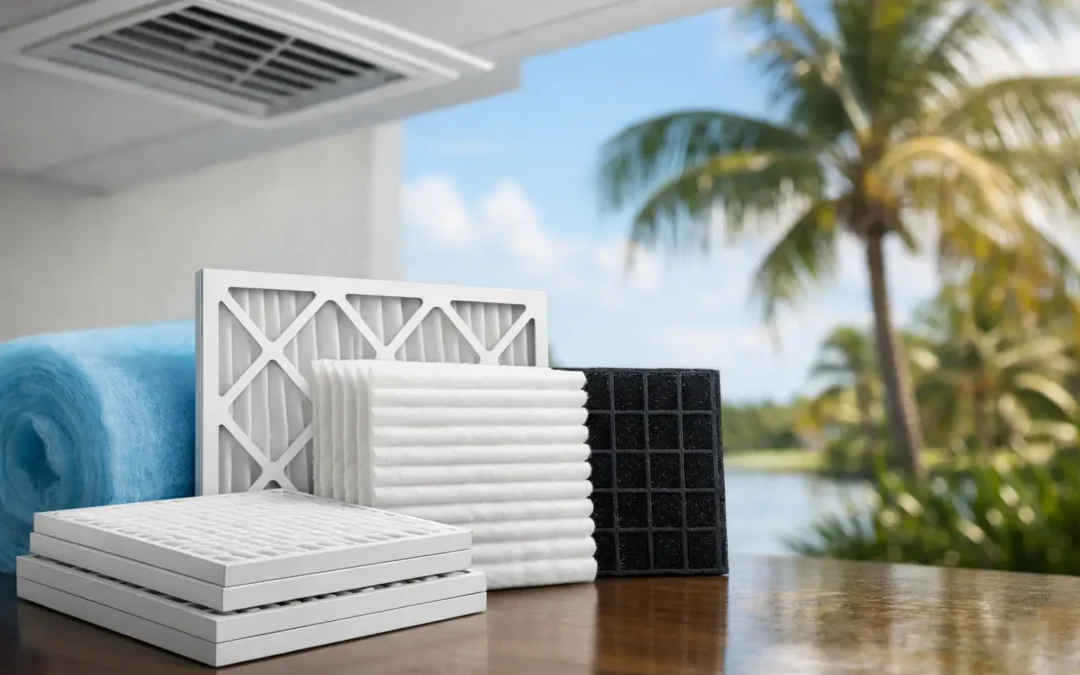
If your AC seems to run nonstop, your house still feels sticky, and dust keeps showing up on the furniture, the filter may be part of the problem. Choosing the best AC filters for Florida humidity is not just about trapping particles. It is also about protecting airflow, helping your system manage moisture, and avoiding the kind of filter choice that makes an already overworked unit struggle even more.
In Southwest Florida, your air conditioner does more than cool the house. It removes moisture, supports indoor comfort, and helps limit the conditions where mildew and musty odors thrive. That is why filter selection matters here more than it might in a drier climate.
What Florida humidity changes about filter choice
High humidity affects both your home and your HVAC system. When outdoor air is heavy with moisture, your AC has to run longer and work harder to keep indoor conditions comfortable. At the same time, homes in areas like Fort Myers, Cape Coral, and North Fort Myers often deal with a mix of fine dust, pollen, pet dander, and seasonal storm debris.
A filter that is too weak may let too many particles pass through the system. A filter that is too restrictive can reduce airflow, which may hurt cooling performance and make humidity control worse. That balance is the real issue.
Many homeowners assume the highest-rated filter is automatically the best one. In practice, that depends on your system design, the condition of your ductwork, and whether your equipment can handle a denser filter without a drop in airflow. In Florida, where airflow problems can quickly turn into comfort problems, that distinction matters.
Best AC filters for Florida humidity: what to look for
For most homes, the sweet spot is a quality pleated filter in the MERV 8 to MERV 11 range. That level usually captures common household particles well without choking airflow in a properly maintained residential system.
Pleated filters are generally a better fit than cheap fiberglass filters because they offer more surface area and better particle capture. Fiberglass filters may protect the equipment from larger debris, but they do much less for indoor air quality. In a humid climate, where dust can cling to damp surfaces and organic particles can contribute to stale smells, that extra filtration makes a difference.
A MERV 8 filter is often a solid baseline for Florida homes. It captures dust, lint, pollen, and some mold spores while still allowing good airflow in many systems. If someone in the home has allergies or there are pets indoors year-round, MERV 10 or MERV 11 may be a better choice.
Going above that can be helpful in certain cases, but it is not always the right move. A MERV 13 filter can trap smaller particles, yet many residential systems are not designed for that level of resistance. If the blower cannot move enough air, you may end up with longer run times, reduced comfort, and extra strain on the system.
Understanding MERV without overcomplicating it
MERV stands for Minimum Efficiency Reporting Value. It is simply a scale that rates how effectively a filter captures particles of different sizes. Higher numbers mean finer filtration, but they also usually mean more resistance to airflow.
For a typical Florida home, think of it this way. MERV 6 to 8 is basic to good filtration. MERV 8 to 11 is often the best balance for comfort, cleanliness, and system performance. MERV 13 and above should be used only if your HVAC system is designed or evaluated for it.
That last point is worth repeating because homeowners often buy a more expensive filter thinking it will automatically improve air quality. Sometimes it does. Sometimes it causes the evaporator coil to get too cold because not enough air is moving across it, which can create bigger performance issues.
Filter types that usually make the most sense
Pleated disposable filters are the most practical option for most households. They are affordable, easy to replace, and available in a wide range of MERV ratings. For the majority of homes, this is the right starting point.
Washable filters sound convenient, but they are often less effective and can become a problem if they are not thoroughly dried before reinstallation. In Florida humidity, anything that stays damp longer than it should can become part of the issue instead of part of the solution.
Electrostatic filters can work well in some systems, but quality varies. Some disposable electrostatic filters perform similarly to other pleated options, while reusable versions require regular cleaning and careful maintenance. If that upkeep gets skipped, performance usually drops quickly.
HEPA filters are rarely appropriate for standard residential HVAC systems unless the system was specifically designed to use them. They are excellent at filtration, but they are too restrictive for most central air setups.
When a better filter helps – and when it does not
A better filter can reduce airborne particles, keep the system cleaner, and improve day-to-day comfort. It may also help cut down on some of the dust that builds up around vents and furniture. But it will not solve every humidity-related complaint.
If your house feels clammy even with a clean, correctly rated filter, the issue may be oversized equipment, leaky ducts, a dirty evaporator coil, poor attic insulation, or a thermostat setting that is not helping moisture removal. In other words, the filter matters, but it is one part of a larger system.
This is where a professional evaluation can save time and money. If a homeowner keeps changing filters hoping to fix humidity, but the system has airflow or drainage issues, the root cause stays in place.
How often to change AC filters in a humid climate
Florida homes usually need more frequent filter changes than homeowners expect. In many cases, every 30 to 60 days is a safer schedule than waiting 90 days.
Homes with pets, ongoing construction nearby, heavy AC usage, or allergy concerns may need a fresh filter every month. A second home that sits empty part of the year may still need regular checks, especially during long cooling seasons when the system runs often.
A clogged filter does more than reduce air quality. It can restrict airflow enough to hurt dehumidification, increase energy use, and add wear to the blower motor and other components. If you hold the filter up and light barely passes through, it is time to replace it.
Signs your current filter may be the wrong one
Sometimes the problem is not that the filter is dirty. It is that the filter is poorly matched to the system or the home.
If certain rooms feel muggy, airflow seems weak at the vents, the AC runs longer than usual, or the system starts freezing up, the filter could be too restrictive. On the other hand, if the system stays clean but the house is still dusty and allergy symptoms never improve, the filter may not be capturing enough.
The right answer depends on both equipment performance and household needs. A home with two dogs and family members with allergies has different filtration priorities than a home occupied seasonally by one person.
Practical advice for Florida homeowners
Start with the manufacturer’s recommended filter size and avoid forcing an ill-fitting filter into the return grille. A gap around the edges lets air bypass the media, which reduces effectiveness no matter how good the filter rating is.
If you are unsure what MERV level your system can handle, do not guess with the highest number on the shelf. A qualified HVAC technician can check static pressure, inspect airflow, and recommend a filter that supports both air quality and system health.
This is especially useful in older homes, homes with past duct modifications, or systems that already struggle during the hottest months. A small filter change can have a bigger effect than many homeowners realize, for better or worse.
For most households, the best path is simple. Choose a quality pleated filter, stay in the MERV 8 to 11 range unless your system is evaluated for more, and replace it on schedule. If humidity, odors, or comfort problems continue, treat that as a sign to look deeper rather than just buying a denser filter.
At Infinite Electric & Air, we see this often in residential systems across Southwest Florida. The homes that stay most comfortable are usually not using the most expensive filter on the shelf. They are using the right filter for the equipment, the home, and the climate.
A good AC filter should help your system do its job, not make that job harder. In a humid Florida home, that balance is what keeps the air cleaner, the airflow steady, and the house feeling like relief when you walk in from the heat.