
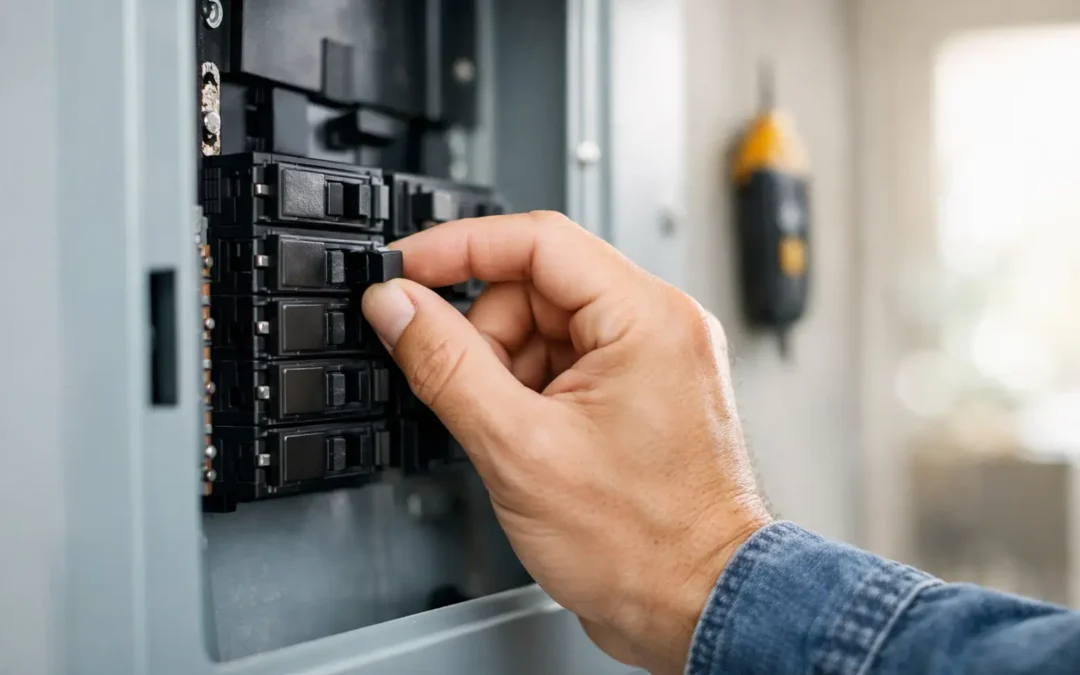
A breaker trips for a reason. Maybe the microwave and coffee maker ran at the same time, or maybe a storm rolled through and your panel took the hit. Either way, if you need to reset a tripped breaker safely, the goal is not just getting the lights back on. It is making sure you are not ignoring a larger electrical problem.
For homeowners, especially here in Southwest Florida where storms, humidity, and heavy AC use put extra strain on home systems, a tripped breaker can be routine or it can be a warning sign. Knowing the difference matters.
What a tripped breaker actually means
Your circuit breaker is designed to protect your wiring and devices from overheating and damage. When it detects too much current on a circuit, or a fault that could be dangerous, it shuts that circuit off.
That is why a tripped breaker is not the same as a power outage. If only part of your home lost power, or one room went dark while the rest of the house stayed on, the panel is one of the first places to check.
In many homes, the breaker handle will not look fully off. It usually lands in a middle position between on and off. That halfway position is often the sign that it has tripped.
How to reset a tripped breaker safely
Before you touch the panel, pause for a minute and look at the situation around you. If there is standing water near the panel, a burning smell, visible scorching, buzzing, or signs of melted wiring, do not try to reset anything. Those are signs you need a licensed electrician right away.
If the area is dry and nothing looks or smells unusual, you can take a careful, basic approach.
Step 1: Turn off or unplug items on that circuit
If the breaker tripped because too many things were running at once, immediately resetting it without reducing the load can cause it to trip again. Unplug space heaters, countertop appliances, window AC units, hair dryers, or any other heavy-use devices on the affected circuit.
If you are not sure what is on that circuit, turn off switches and unplug what you can in the room or area that lost power.
Step 2: Stand safely and use one hand
Make sure your hands are dry and the floor is dry. Stand to the side of the panel rather than directly in front of it. This is a standard safety habit because electrical panels can be hazardous if there is an internal fault.
Using one hand is also a smart precaution. It reduces the chance of creating a path for current across your body if something is wrong.
Step 3: Move the breaker fully to OFF
This step gets missed all the time. A tripped breaker usually has to be pushed completely to the off position before it can be reset. If you only try to nudge it back toward on, it may not reset properly.
Use firm pressure, but do not force it.
Step 4: Flip it back to ON
Once the breaker is fully off, move it back to the on position. If it stays on and power returns, watch the circuit for a while. If it trips again right away, stop there. Repeated tripping usually means the problem is not random.
When a reset is probably enough
Sometimes a trip is just an overload. That is common in kitchens, laundry areas, garages, and older homes where modern power needs exceed the original circuit design.
A one-time trip may not be serious if you can clearly identify the cause. For example, if you were running the toaster oven, blender, and coffee maker on the same circuit and the breaker tripped once, reducing the load may solve it.
The same can be true after a storm-related power event. In parts of Florida, surges and brief service interruptions can occasionally cause breakers to trip. If the breaker resets normally and does not trip again, that may be the end of it.
When not to keep resetting the breaker
A breaker that trips more than once is doing its job. The mistake is treating it like an inconvenience instead of a warning.
Signs the issue may be more serious
If any of these apply, it is time to stop resetting and have the system checked:
- The breaker trips immediately after you reset it
- It trips even when nothing is plugged in
- You notice a burning smell, warm outlets, or discoloration
- The panel buzzes or crackles
- One breaker feels loose or will not stay firmly set
- The same circuit trips repeatedly over days or weeks
- The breaker controls major equipment like your AC condenser, water heater, or dryer
In those cases, the problem could be a short circuit, ground fault, damaged wiring, a failing breaker, or a load issue that needs correction at the panel level.
Why breakers trip in Florida homes
Not every home in Southwest Florida has the same electrical demands it had ten or twenty years ago. Larger TVs, extra refrigerators, garage freezers, pool equipment, EV chargers, and home office setups all add load. At the same time, air conditioning systems run hard for much of the year.
That combination can expose weaknesses in older panels or crowded circuits.
Storms are another factor. Lightning activity, utility disturbances, and power fluctuations can stress electrical systems. Surge protection helps, but it does not eliminate every issue. If your breaker panel has been acting up after a storm, that deserves more than a quick reset and a shrug.
The difference between overload, short circuit, and ground fault
This is where the “why” matters.
An overload happens when the circuit is simply asked to deliver more current than it is designed to handle. This is the most common and often the least severe cause.
A short circuit is different. That is when a hot wire contacts a neutral wire or another unintended path, causing a sudden spike in current. This can create heat and damage fast.
A ground fault happens when electricity takes an unintended path to ground, often involving metal parts or moisture. In bathrooms, kitchens, garages, and outdoor areas, this can be especially dangerous.
From a homeowner perspective, you usually cannot diagnose the exact cause just by looking at the breaker handle. If the trip was clearly tied to too many devices on one circuit, that is one thing. If not, professional testing is the safest next step.
What not to do when you reset a tripped breaker safely
A few mistakes can turn a minor issue into a real hazard.
Do not force a breaker that feels stuck. Do not tape a breaker in place or try to hold it on. Do not ignore scorch marks or heat around the panel. And do not replace a breaker with a larger one unless a licensed electrician has confirmed the wiring and circuit are rated for it.
That last one is especially dangerous. A breaker is sized to protect the wire behind the walls. Installing the wrong size breaker can allow wiring to overheat before the breaker trips.
If the breaker keeps tripping, what comes next
At that point, the smart move is not another reset. It is finding the cause.
A licensed electrician may inspect the breaker itself, test the circuit, check for loose connections, evaluate connected appliances, and look at whether your panel is still the right fit for your home’s current electrical demand. Sometimes the fix is simple, like replacing a worn breaker or moving appliances to a different circuit. Other times, the issue points to an outdated panel, failing component, or wiring defect that needs repair.
For homeowners in Cape Coral, Fort Myers, North Fort Myers, and nearby communities, this is one of those situations where local experience matters. Homes here deal with weather, heat, and usage patterns that can be hard on electrical systems. A proper diagnosis protects more than convenience. It protects your home.
A few practical habits that help prevent future trips
If you have had one nuisance trip, pay attention to what was running at the time. Spreading out high-draw appliances often helps. It is also worth labeling your panel clearly if it is not already. That makes future issues faster and safer to handle.
If your home has frequent trips, flickering lights, or an older panel, do not wait for a bigger failure. Preventive electrical service is often less disruptive and less costly than emergency repairs.
Infinite Electric & Air works with homeowners every day who are trying to sort out whether a breaker trip was a simple overload or a sign of a deeper issue. If you are ever unsure, it is better to ask than to keep resetting and hoping for the best.
A breaker should give you peace of mind, not a recurring mystery. If yours keeps speaking up, it is worth listening.