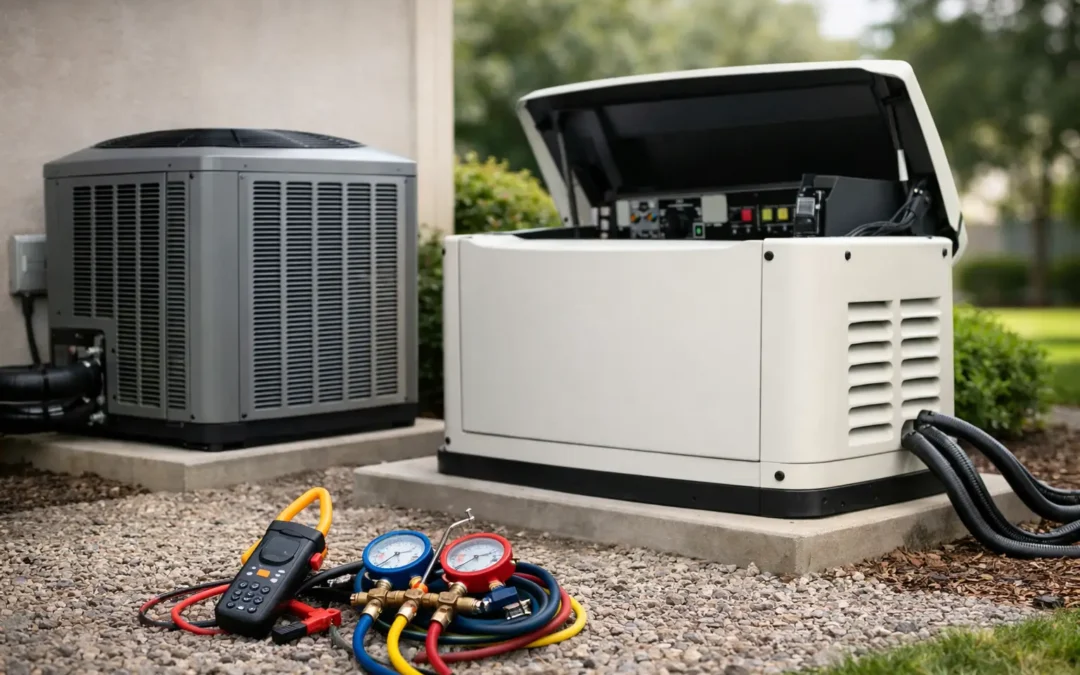
When the power goes out in Southwest Florida, the first question many homeowners ask is simple: will the AC still run? That is exactly why a practical guide to sizing generator for HVAC matters. If your generator is too small, it may trip, stall, or fail to start your system. If it is too large, you may spend more than necessary on equipment, fuel, and installation.
For homeowners, generator sizing is not really about picking a machine with the biggest number on the label. It is about matching the generator to how your HVAC system actually behaves, especially at startup. Air conditioners and heat pumps do not draw power the same way a lamp or refrigerator does. They have compressors, blower motors, and sometimes electric heat strips, all of which can change the sizing math.
Why HVAC generator sizing is different
Your HVAC system usually has two kinds of electrical demand. The first is running wattage, which is the power needed to keep the system operating once it is on. The second is startup wattage, sometimes called surge or inrush current. That startup demand can be much higher for a few seconds, especially when the compressor kicks on.
That brief surge is where many sizing mistakes happen. A generator may appear large enough based on normal running numbers, but still struggle when the outdoor unit starts. In real life, that can mean lights dimming, the system short cycling, or the generator shutting down on overload.
In Florida homes, this issue matters even more because cooling is not just a comfort concern during a summer outage. High indoor temperatures and humidity can become a health and home protection issue quickly. That is why proper sizing should account for actual operating conditions, not just best-case assumptions.
A guide to sizing generator for HVAC starts with the system type
Before you can estimate generator capacity, you need to know what kind of HVAC equipment you have. A central air conditioner paired with a gas furnace has very different power needs than a heat pump with electric auxiliary heat. A ductless mini-split also behaves differently from a larger split system.
If your home has central AC with a gas furnace, the generator usually needs to support the outdoor condensing unit and the indoor blower. If your home has a heat pump, the load may be higher because the system provides both cooling and heating. If electric resistance heat strips are part of the system, that can dramatically increase generator requirements.
This is where homeowners can get tripped up. They may hear that a 5-ton system needs a certain size generator, but tonnage alone does not tell the full story. Equipment efficiency, compressor design, age, and accessories like soft starters all affect the final number.
What information to gather before sizing
A good estimate starts with the equipment nameplates and model information. The outdoor condenser and indoor air handler or furnace both matter. You are looking for values such as voltage, minimum circuit ampacity, rated load amperes, and locked rotor amperes. Locked rotor amperes is especially important because it helps show the compressor’s startup demand.
You also need to think beyond the HVAC itself. Most homeowners do not want a generator that powers only the AC and nothing else. During an outage, you may also want refrigeration, lighting, internet, outlets, a well pump, or medical equipment. Those loads have to be added into the plan.
The right generator size depends on whether you want partial-home backup or whole-home backup. Partial-home systems focus on essentials and may or may not include air conditioning. Whole-home systems are designed to carry more of the house as it normally operates, but they require a larger investment and often a more detailed load calculation.
How generator sizing is typically calculated
At a basic level, sizing involves adding the running wattage of all intended loads and then accounting for the largest startup load. For HVAC, the compressor is often the biggest factor. A licensed electrician or generator specialist will usually calculate this in kilowatts, then compare it to the generator’s continuous output and motor-starting capability.
This is not always as straightforward as multiplying volts and amps from a label. Some nameplate values are for branch circuit sizing, not actual operating demand. Real performance can vary based on system condition, outdoor temperature, and how many components start at once.
That is why professional load testing and equipment review are so valuable. Two homes with similar square footage can need very different generators if one has a high-efficiency variable-speed system and the other has older equipment with a heavy startup draw.
Why soft starters can change the equation
A soft starter reduces the initial electrical surge when the compressor starts. In some cases, that allows a smaller generator to start and run an air conditioner more reliably. It does not reduce the system’s cooling capacity, but it can make generator planning more practical.
That said, a soft starter is not a cure-all. It has to be compatible with your equipment, installed correctly, and factored into a broader electrical plan. It may help reduce the generator size you need, but it should never be used as a shortcut around proper load calculations.
Common sizing mistakes homeowners make
One common mistake is using square footage alone to choose a generator. Square footage can help size air conditioning equipment, but it is not enough to size backup power. Generator sizing depends on electrical demand, not just home size.
Another mistake is assuming the HVAC nameplate tells the whole story. Those labels are important, but they do not always reflect actual startup behavior under real conditions. Age, maintenance history, and wiring setup matter too.
Homeowners also sometimes forget about humidity control. In Southwest Florida, keeping the AC running during an outage is not only about temperature. Your HVAC system helps remove moisture from indoor air. Without it, your home can feel hotter, and excess humidity can affect comfort, indoor air quality, and even materials inside the home.
The last major mistake is planning for cooling but ignoring heating mode. While Florida winters are mild, heat pump systems can draw differently in heating mode, especially if auxiliary heat comes on. If you want year-round backup capability, that needs to be part of the design.
Portable vs standby generators for HVAC loads
Some portable generators can support smaller HVAC applications, especially with load management or a soft starter. But for central air systems, this setup often comes with trade-offs. You may need to limit what else runs in the home, manage cords or manual transfer equipment, and accept less convenience during storms.
Standby generators are usually the more dependable option for whole-home or major-load backup. They are permanently installed, connected to a transfer switch, and designed to turn on automatically during an outage. For many homeowners, that reliability is the real value, especially during overnight outages or when they are away from home.
The right choice depends on your goals. If you only want to maintain a few essentials for short outages, a portable unit may be enough. If you want your HVAC system to operate with less interruption and less guesswork, a standby generator is often the better fit.
Why professional sizing matters
Electrical and HVAC systems intersect in ways that are easy to underestimate. The generator has to match not just the HVAC equipment, but also the panel capacity, transfer switch setup, fuel source, and code requirements. Safe installation matters just as much as correct sizing.
A licensed professional can evaluate whether your existing electrical system is ready, whether load shedding should be part of the design, and whether your air conditioning equipment may benefit from a soft starter or other upgrades. That level of planning helps avoid expensive surprises after installation.
For homeowners in places like Cape Coral, Fort Myers, and North Fort Myers, storm preparation is not theoretical. A properly sized generator can protect comfort, reduce stress, and help your home stay safer during long outages. At Infinite Electric & Air, this is exactly why generator and HVAC planning should be treated as one connected decision, not two separate projects.
What to expect from the sizing process
A professional sizing visit usually starts with a review of your HVAC equipment, electrical panel, and the loads you want backed up. From there, the contractor can estimate starting and running demands, discuss fuel options such as natural gas or propane, and explain whether partial-home or whole-home backup makes more sense.
You should also expect a conversation about trade-offs. A smaller generator may require prioritizing certain circuits. A larger one may provide more flexibility but increase upfront cost. The best answer is rarely the biggest unit available. It is the one that supports your home safely, reliably, and within your budget.
If you are thinking about backup power, start with the AC system you already have, not just the generator brochure. The smartest plan is the one built around how your home actually runs when the weather is at its worst.