If your home always seems dusty, your allergies flare up when the AC kicks on, or certain rooms feel stale no matter how often you clean, it may be time to look beyond portable units. The best whole house air purifier options work with your HVAC system to clean the air across your entire home, not just in one bedroom or living room.
For many homeowners in Southwest Florida, that difference matters. We spend a lot of time indoors with the air conditioning running, especially during long cooling seasons. That means indoor air quality is tied closely to how well your HVAC system filters particles, manages humidity, and keeps contaminants from circulating through the ductwork.
What whole-house air purification actually means
A whole-house air purifier is not one single product type. It is a category of indoor air quality solutions installed within or alongside your central HVAC system. These systems treat the air as it moves through your return and supply ducts, helping reduce particles, odors, and in some cases biological contaminants.
That last part is where many homeowners get tripped up. One product may be excellent at capturing dust and pet dander but do little for odors. Another may help address bacteria on HVAC components but not remove larger airborne particles very effectively on its own. The right choice depends on what you are trying to solve.
Best whole house air purifier options for most homes
The best fit usually comes down to three main options: high-efficiency media filters, UV air purification systems, and active air purification products such as air scrubbers or ionization-based systems. In some homes, a combination of two approaches gives the best result.
High-efficiency media filters
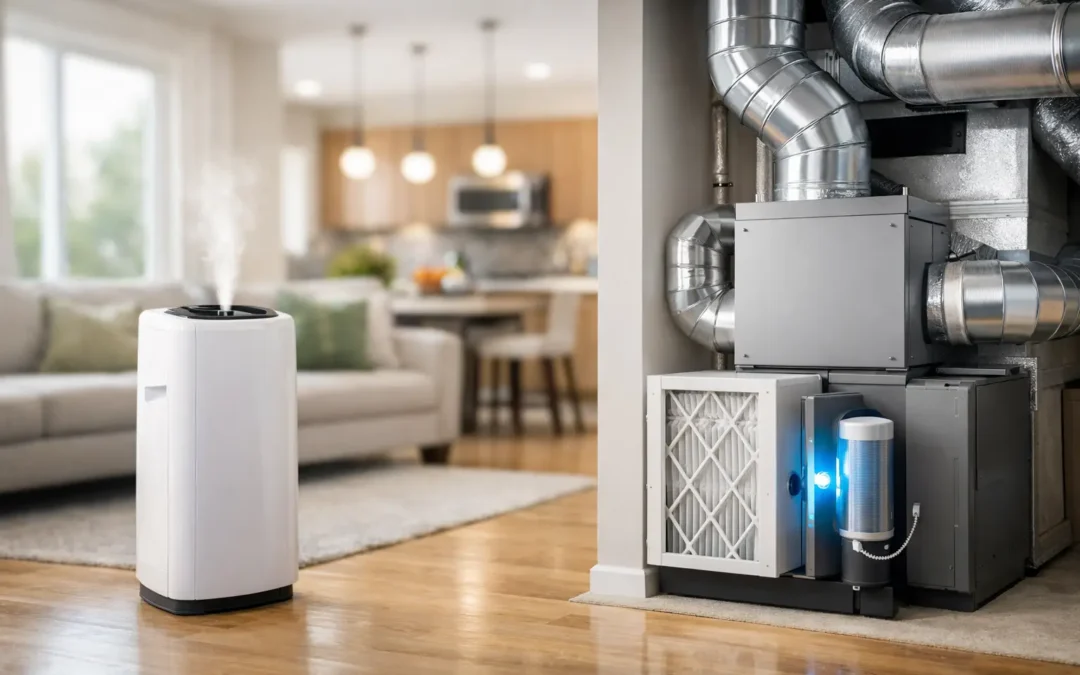
A media filter is often the most practical starting point. These filters are thicker than standard one-inch filters and are installed in a dedicated cabinet near the air handler. Because they have more surface area, they can capture smaller particles without restricting airflow as quickly as a basic filter.
For homes dealing with dust, pollen, lint, and pet dander, a quality media filter can make a noticeable difference. It is also one of the more straightforward upgrades because it works passively with your existing HVAC system.
The trade-off is that a media filter only captures what passes through it. It does not actively neutralize odors or address microbial growth inside the system. It also has to be matched properly to the equipment. A filter with too high a resistance can reduce airflow, which is a serious issue in air conditioning performance and efficiency.
UV air purifiers
UV systems use ultraviolet light, typically installed near the evaporator coil or inside the air handler, to target microbial growth. In Florida’s humid climate, that can be especially useful because moisture around the coil can create conditions where mold and biofilm develop.
A UV light is best thought of as a targeted tool, not a complete air cleaning system. It can help keep internal HVAC components cleaner and may reduce certain biological contaminants, but it is not a replacement for proper filtration. If your main concern is visible dust around your home, a UV light alone will not solve it.
Still, for homeowners concerned about mold growth inside the system, UV can be a smart add-on. It is often most effective when paired with a media filter.
Air scrubbers and active purification systems
Active systems are designed to do more than trap particles. Depending on the product, they may reduce odors, help with smoke residue, and target very small airborne contaminants through ionization or other technologies. These are often the products people mean when they ask for a whole-house air purifier rather than just better filtration.
This category can be helpful in homes with pets, cooking odors, lingering mustiness, or recurring indoor air quality complaints that basic filtration has not solved. Some homeowners also choose these systems after remodeling work or after dealing with seasonal air quality concerns.
The important caution is that not all active purification systems perform the same way. Product quality matters, and installation matters just as much. You want a system that is properly sized, safely installed, and appropriate for your HVAC setup. This is not an area where guessing based on product packaging is a good idea.
How to choose among the best whole house air purifier options
The fastest way to narrow your options is to identify the problem you want to solve first.
If your biggest issue is dust, pollen, or pet hair, start with filtration. A properly installed media filter often delivers the best value. If you are worried about microbial growth inside the unit, especially around the coil, UV treatment may make sense. If your concerns include odors, smoke, or a general sense that the indoor air feels dirty even with decent filtration, an active purification system may be worth considering.
In many cases, the best answer is layered. A media filter handles larger and smaller particles. UV protects key HVAC surfaces. An active purifier addresses the contaminants that filtration alone may miss. That combination is not necessary for every home, but it can be effective when indoor air quality problems are coming from multiple sources.
Your HVAC system still has to breathe
One of the most common mistakes is choosing the most aggressive filter possible and assuming more filtration is always better. It depends on the system. Air conditioners are designed to move a specific amount of air. If a filter creates too much restriction, your comfort can suffer, your system can work harder, and your energy use may increase.
That is why the best whole house air purifier options are not just about the product itself. They are about compatibility with your air handler, duct design, and maintenance routine. A good indoor air quality upgrade should support system performance, not compromise it.
What matters more in Florida homes
In Southwest Florida, indoor air quality is tied closely to humidity control. If your home feels damp, smells musty, or develops mildew around vents, an air purifier alone may not fix the real problem. Excess moisture can make indoor air feel worse even when filtration is decent.
That is why homeowners in places like Cape Coral, Fort Myers, and North Fort Myers often benefit from looking at the full picture. Filtration, humidity levels, duct condition, and AC maintenance all work together. If one part is off, the air in the home usually reflects it.
For example, a home with leaky return ducts may keep pulling in dusty attic air. A clogged drain line or dirty evaporator coil may contribute to moisture issues. An oversized AC system may cool quickly without removing enough humidity. In those situations, adding a purifier can help, but it should not be the only step.
Installation and maintenance matter more than marketing
A well-made air purification product can still underperform if it is installed in the wrong location, paired with the wrong filter, or left unmaintained. Media filters need scheduled replacement. UV bulbs lose effectiveness over time and need periodic replacement even if they still appear to be on. Active systems should be inspected to make sure they are operating correctly and safely.
This is where working with a licensed HVAC professional matters. The goal is not just to sell a device. It is to improve air quality without creating airflow problems, electrical issues, or unnecessary maintenance headaches.
If you are already planning AC service or system upgrades, that is often the best time to ask about indoor air quality options. It allows the technician to evaluate your system as a whole and recommend solutions that match your home and your concerns.
So which option is best?
For many households, a high-efficiency media filter is the best first investment because it improves air quality in a meaningful way without overcomplicating the system. If there is concern about mold or microbial growth inside the air handler, UV can be a strong companion option. If odors, smoke, or persistent air quality complaints are part of the picture, an active whole-house purifier may be the better fit.
There is no single product that is best for every home. The best choice is the one that addresses your actual air quality issues, works with your HVAC system, and can be maintained consistently over time.
At Infinite Electric & Air, we see this often with homeowners who are trying to fix dust or comfort issues by changing filters over and over, only to find the real answer involves better system design, better humidity control, or a more appropriate air purification setup. Cleaner air usually starts with a clear diagnosis.
If your home air never feels as fresh as it should, start by asking what your HVAC system is really doing with the air it moves every day. The right upgrade should make your home feel cleaner, more comfortable, and easier to live in – not just add one more gadget to maintain.