
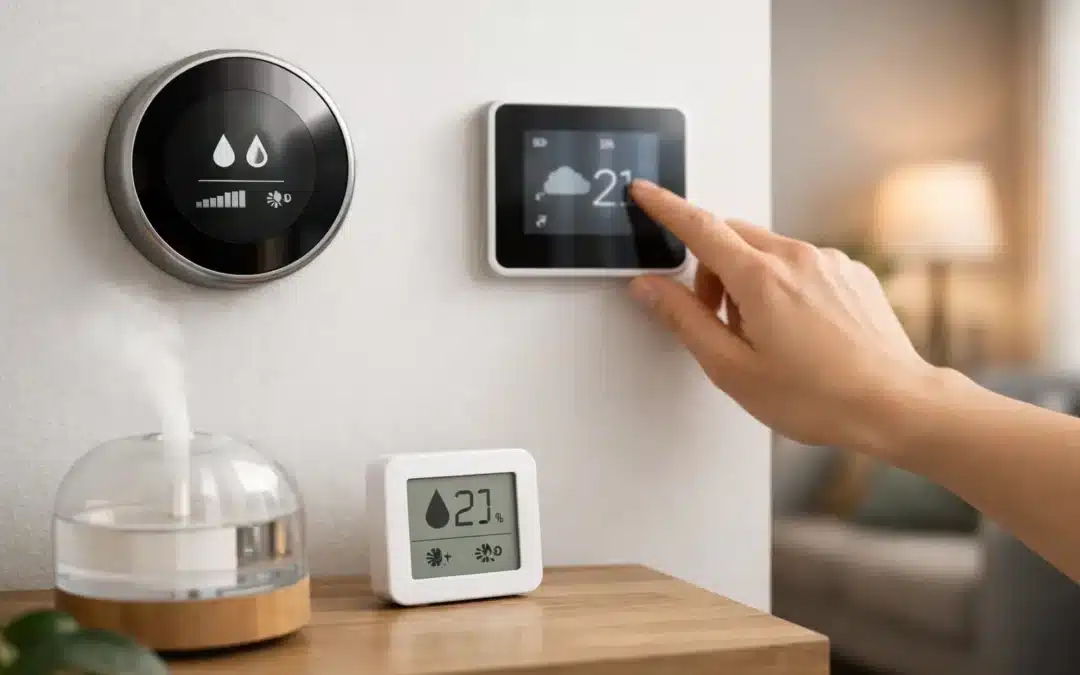
If your thermostat says 74 but your house still feels sticky, temperature is only part of the story. The best smart thermostats for humidity control help your AC manage comfort more precisely, which matters a lot in Florida homes where damp indoor air can make rooms feel warmer, strain your system, and leave the whole house feeling less comfortable.
A smart thermostat will not solve every humidity problem by itself. In many homes, indoor moisture issues come from oversized equipment, leaky ductwork, poor insulation, long shower and cooking cycles, or the simple fact that Southwest Florida air carries plenty of moisture most of the year. Still, the right thermostat can absolutely help by running your system more intelligently, pairing with dehumidification settings, and giving you clearer control over indoor conditions.
What actually matters in a humidity-control thermostat
When homeowners shop for thermostats, it is easy to focus on the screen, app, or brand name. For humidity control, the more important question is how the thermostat works with your specific HVAC equipment.
A good model should display indoor humidity and let you track changes over time. Better models can do more than monitor. They can control whole-home dehumidifiers, manage variable-speed systems, or use settings that continue the cooling cycle just long enough to pull extra moisture from the air. That difference matters because removing humidity and lowering temperature are related, but they are not the same thing.
Compatibility is the big trade-off. Some thermostats have excellent humidity features, but only if your equipment supports them. A premium thermostat connected to a basic single-stage system may offer useful monitoring, but not advanced dehumidification. On the other hand, a thermostat designed for communicating equipment can do far more when paired correctly.
The 7 best smart thermostats for humidity control
Ecobee Smart Thermostat Premium
For many homeowners, this is the strongest all-around option. Ecobee gives you indoor humidity readings, strong scheduling tools, remote access, and support for accessories such as whole-home humidifiers and dehumidifiers. It also has occupancy features and room sensors, which help balance comfort beyond the hallway where the thermostat sits.
What makes it stand out for humidity control is flexibility. It works well in many residential setups and gives you more granular control than some competing smart thermostats. If your HVAC system and wiring support dehumidification, Ecobee can be a very practical choice.
The trade-off is setup. It is not usually difficult, but homeowners with older systems or accessory equipment may want professional installation to make sure every control wire and setting is correct.
Honeywell Home T9 or T10+
Honeywell has a long track record in HVAC controls, and that experience shows. The T9 and especially the T10+ are strong picks when humidity control matters and the home may have more advanced equipment. These models offer smart scheduling, remote sensors, and dependable app control.
The T10+ deserves extra attention because it is often a better fit for more complex residential systems. If your home includes IAQ accessories or staged equipment, this thermostat can be a smart choice. It tends to appeal to homeowners who want professional-grade control without a lot of unnecessary flash.
The main consideration is that model selection matters. The right Honeywell thermostat depends heavily on your equipment type, so this is not a category where guessing is a good idea.
Carrier Infinity Smart Thermostat
If you have a Carrier Infinity system, this is one of the best smart thermostats for humidity control available. In the right matched system, it can actively manage temperature, fan speed, and moisture removal at a much deeper level than a universal thermostat.
That is the upside of a communicating system. The thermostat is not just sending simple on-off commands. It is coordinating with the equipment to improve comfort and efficiency. In a humid climate, that can make a noticeable difference.
The downside is simple. This thermostat is best within the Carrier ecosystem. If you do not have compatible Carrier equipment, it is not the right fit.
Trane ComfortLink II XL1050
For homes with compatible Trane systems, the XL1050 is another excellent humidity-focused option. It offers detailed control, strong system integration, and the kind of communication features that help variable-speed or higher-end systems do what they were designed to do.
In practical terms, that means better management of runtimes and airflow, which often helps reduce that cold-but-clammy feeling some Florida homeowners know too well. It can also be a good option for larger homes where comfort varies room to room.
Like other brand-specific communicating thermostats, the limitation is compatibility. This is a great thermostat in the right system and the wrong one in the wrong system.
Lennox iComfort S30
The Lennox iComfort S30 is built for Lennox communicating equipment and offers strong humidity-related performance when properly paired. It gives detailed system data, smart controls, and good support for indoor air quality components.
For homeowners already invested in a Lennox system, this thermostat can help the equipment operate the way it was intended. That often means quieter operation, more even comfort, and better moisture removal during long cooling seasons.
The drawback is similar to Carrier and Trane. This is a specialized option, not a universal recommendation.
Google Nest Learning Thermostat
Nest remains popular because it is clean, easy to use, and widely recognized. It can display humidity levels and give homeowners simple smart control through an app. For a straightforward system where convenience matters most, it can still be a solid thermostat.
But this is where honesty matters. Nest is not usually the best choice if humidity control is your top priority and you need deeper HVAC integration. It handles many standard comfort tasks well, but it may not offer the same level of dehumidification control as thermostats designed with more advanced HVAC features in mind.
If you want simple smart control and useful humidity monitoring, it can work. If you want a thermostat to coordinate aggressively with dehumidification hardware or communicating equipment, there are better choices.
Emerson Sensi Touch 2
The Sensi Touch 2 is a practical option for homeowners who want smart features without overcomplicating things. It has good app functionality, indoor humidity display, and a reputation for being relatively installer-friendly in many homes.
This thermostat is often a good fit for standard systems where the goal is to improve visibility and basic control rather than create a highly customized IAQ setup. It can be a nice middle ground between budget and features.
Its limitation is that it does not match the deeper system control you get from some premium or communicating models. For many households, that is perfectly fine. For homes with persistent humidity issues, it may not go far enough on its own.
How to choose the best smart thermostat for humidity control in your home
Start with your equipment, not the thermostat display. If you have a variable-speed system, staged cooling, or a whole-home dehumidifier, the best thermostat is usually the one that can fully communicate with those components. If you have a more basic single-stage system, your best option may be a versatile universal thermostat that monitors humidity well and supports available dehumidification functions.
Next, think about what problem you are trying to solve. If the house feels humid in the afternoon, thermostat settings may help. If windows are sweating, rooms smell musty, or some areas stay damp no matter what, the issue may involve airflow, insulation, return air design, duct leakage, or equipment sizing.
That is especially true in Southwest Florida, where long cooling seasons and outdoor moisture put extra pressure on residential HVAC systems. In this climate, a thermostat should be part of a bigger comfort strategy, not the only tool.
Features worth paying for and features you can skip
Humidity readings are worth having. If you cannot see indoor humidity, it is harder to know whether comfort complaints are really temperature problems or moisture problems. App access is also useful because it lets you monitor trends and make adjustments without standing in front of the wall unit.
Advanced learning features are more optional. Some homeowners love them, and others find that manual schedules work better. Built-in voice assistant features are rarely the reason a thermostat improves comfort. For most households, system compatibility and dehumidification capability matter much more than novelty.
Remote sensors can be valuable if your home has hot or muggy rooms that never feel right. They do not directly remove humidity, but they help the system respond more accurately to real living spaces.
A quick reality check on humidity control
A thermostat can help your AC remove moisture more effectively, but it cannot compensate for an HVAC system that is too large and short-cycles. It also cannot fix duct issues or poor home sealing. If your home constantly feels sticky even with a quality thermostat, there may be a deeper system issue worth evaluating.
That is where professional guidance helps. A licensed HVAC team can check whether your thermostat, air handler settings, refrigerant performance, drainage, duct system, and equipment sizing are all working together. Infinite Electric & Air often sees homeowners focus on the wall control when the real comfort issue starts elsewhere in the system.
The right thermostat should make your home feel better, not just look smarter on the wall. If you choose one that matches your equipment and your home’s actual humidity challenges, you will usually notice the difference where it counts most – in how comfortable your house feels at the end of a hot, damp day.