
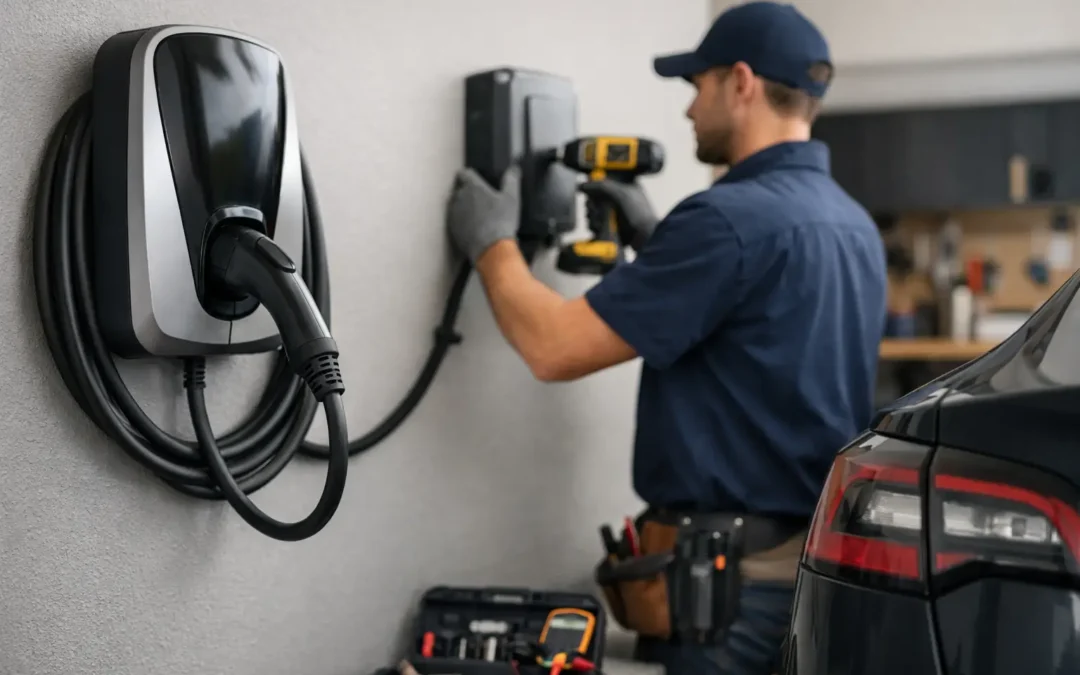
If you are ready to install EV charger in garage, the biggest mistake is treating it like a simple outlet swap. A home charger pulls significant power for hours at a time, and that means your panel capacity, wiring, breaker sizing, and garage layout all matter from day one. Done right, charging is fast, convenient, and safe. Done poorly, it can create nuisance breaker trips, overheating, and expensive rework.
For many homeowners, the appeal is obvious. You park at night, plug in, and wake up with the range you need. But the right setup depends on your vehicle, your driving habits, and your home’s electrical system. In Southwest Florida, it also helps to think about humidity, storms, and surge protection, because your charger is another major electrical investment connected to the home.
What it takes to install EV charger in garage
Most garages can support EV charging, but not every garage is ready for Level 2 charging without some electrical work. Level 1 charging uses a standard 120-volt outlet and is slow. It can work for very light daily driving, but many homeowners quickly find it too limiting. Level 2 charging uses 240 volts and charges much faster, which is why it is the most common choice for a permanent garage installation.
A proper installation usually starts with load calculations. Your electrician needs to look at what your panel can safely handle, including large loads like your air conditioner, electric water heater, dryer, oven, and pool equipment. A garage charger is not installed in isolation. It becomes part of the total demand on your home.
The next question is charger type. Some vehicles come with flexible charging equipment, but many homeowners prefer a wall-mounted Level 2 unit with smart features, better cable management, and dedicated circuitry. Hardwired chargers are often the cleaner and more durable option. Plug-in chargers can also work well, but they require the correct receptacle, proper breaker sizing, and attention to local code requirements.
Start with your panel and electrical capacity
Before you choose a charger brand or compare app features, find out whether your electrical panel has the capacity to support it. This is often the deciding factor in cost.
A newer home may have enough available capacity for a 40- or 50-amp EV circuit with minimal changes. An older home may need a panel upgrade, a subpanel, or a load management solution. If your lights already flicker when major appliances start, or if your panel is full, that is a sign to slow down and have the system evaluated first.
There is no one-size-fits-all answer here. A homeowner who drives 20 miles a day may be perfectly served by a lower-amperage charger. Another homeowner with a long commute or multiple EVs may want higher charging speeds. Faster charging sounds better, but it is not always necessary. Higher amperage can mean heavier wire, more labor, and in some cases a larger electrical upgrade.
That is where a professional assessment pays off. A licensed electrician can calculate your actual needs and recommend a setup that fits both your home and your budget.
Do you need a panel upgrade?
Maybe, maybe not. If your existing service is undersized or your panel is already crowded with major loads, an upgrade may be the safest path. If your system is in good shape, you may only need a new dedicated breaker and properly sized wiring.
For homeowners in areas like Cape Coral or North Fort Myers, this is also a good time to think bigger than the charger itself. If your panel is borderline now, adding an EV charger might be the point when it makes sense to upgrade for future needs, especially if you are also considering surge protection, a generator connection, or other electrical improvements.
Where the charger should go in the garage
Placement affects convenience more than most people expect. The best location depends on where the vehicle’s charge port sits, how you park, and how much cable reach the charger provides. Mounting it too far from the parking position leads to awkward stretching, cable wear, and daily frustration.
A good installation keeps the charging cable off the floor as much as possible and away from areas where it can be pinched, tripped over, or exposed to impact. The wall location should also allow for proper working clearance and follow manufacturer instructions for mounting height and spacing.
If your garage doubles as a workshop, storage area, or laundry space, mention that during the estimate. Real-life use matters. The charger should fit the way you actually move through the space, not just the empty-wall version of the garage.
Hardwired vs. plug-in chargers
Both can be code-compliant when installed correctly, but they serve slightly different priorities. Hardwired chargers are permanently connected and often preferred for a cleaner look, fewer connection points, and strong long-term reliability. Plug-in chargers offer a bit more flexibility if you think you may replace or relocate the unit later.
The trade-off is that plug-in installations still require the correct outlet type and proper installation for a high continuous load. This is not the place for improvised adapters or off-the-shelf shortcuts.
Permits, code, and why DIY is risky
A garage EV charger may look simple once it is on the wall, but the work behind it is not casual DIY territory. This is a high-load circuit that must be sized and installed correctly, and local permitting is typically required.
Permits matter because they help verify that the breaker, wire size, grounding, overcurrent protection, and installation method meet code. They also matter for insurance, resale, and peace of mind. If work is done without permits and something goes wrong later, the savings disappear quickly.
This is especially true in Florida, where electrical systems deal with heat, moisture, and storm-related risks. A licensed electrician understands not only the charger installation itself, but also how it fits into the broader safety of the home.
What affects the cost to install EV charger in garage
Homeowners often ask for a flat price, but the range can vary quite a bit. The charger unit is only one part of the total cost. Labor, permit fees, breaker space, wire length, wall construction, and panel upgrades can all change the number.
If the panel is in the garage close to the charger location, the job is usually more straightforward. If the panel is far away, the wire run may require more time and materials. If your home needs a service or panel upgrade first, that becomes the bigger project.
Smart charger features can also affect cost, although not always installation cost. Wi-Fi scheduling, usage tracking, and utility-friendly charging controls can be useful, especially if you want better visibility into power use. But those features are only worth paying for if you will actually use them.
The best estimate is one based on your actual home, not a generic number pulled from online averages.
Safety features worth considering
An EV charger is a major electrical appliance, and safety should lead the decision. Ground-fault protection, proper breaker sizing, manufacturer-listed equipment, and correct wire installation are non-negotiable.
In Southwest Florida, whole-home surge protection is also worth discussing. Between summer storms and utility disturbances, sensitive electronics throughout the home can benefit from better protection, and your EV charging equipment is no exception.
It is also wise to think about future service access. A good installation leaves room for maintenance, clear labeling in the panel, and a setup that another licensed technician can evaluate easily years from now.
Choosing the right installer
The right contractor will do more than hang a charger and leave. They should review your panel capacity, explain whether you need permits, discuss charger options without pushing unnecessary upgrades, and provide clear pricing.
Look for a licensed and insured electrical professional who is comfortable evaluating residential service capacity, not just swapping fixtures. Ask how they determine circuit sizing, whether they handle permitting, and what happens if the panel needs more work than expected.
A trustworthy installer will also be honest about trade-offs. Sometimes the fastest charger is not the smartest choice. Sometimes a moderate-speed charger on a properly designed circuit gives you everything you need without overbuilding the project.
For homeowners who want a dependable setup without guesswork, Infinite Electric & Air approaches EV charger installations the same way we approach all home electrical work – with safety, code compliance, and clear communication first.
When it makes sense to move forward
If you already own an EV, a Level 2 garage charger is often one of the most practical home upgrades you can make. If you are still shopping for the vehicle, it can still make sense to prepare early, especially if your panel is aging or you are planning other electrical improvements.
The key is to install for your actual needs, not just the biggest number on the box. A charger that matches your driving routine, fits your garage, and works with your home’s electrical system will serve you better than an oversized setup that strains the panel or inflates the cost.
A well-installed charger should feel simple every time you use it. That kind of simplicity comes from careful planning upfront, and it is worth getting right before the first plug-in.