
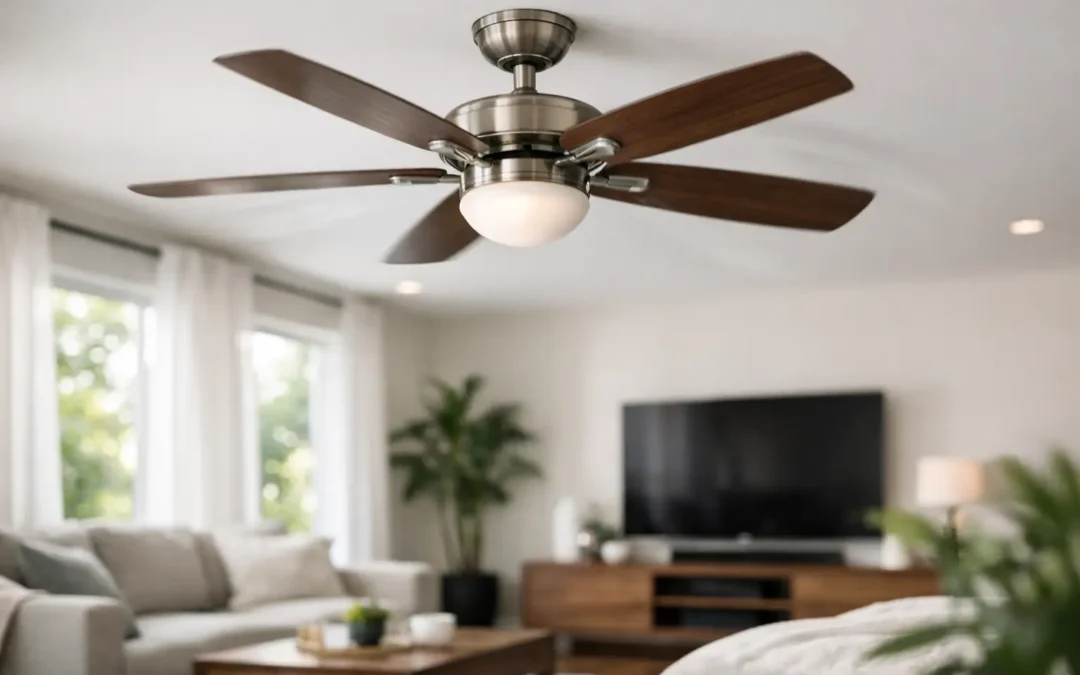
If one room in your house always feels warmer than the rest, the problem is not always your air conditioner. In many Florida homes, better air movement makes a noticeable difference, which is why homeowners often ask about the best ceiling fans for cooling rooms before they invest in bigger HVAC changes. A well-chosen fan can help a room feel several degrees cooler, improve comfort, and reduce the strain on your AC system.
That said, not every ceiling fan actually cools a room well. Some look great but move very little air. Others are oversized for the space, noisy at higher speeds, or installed too low for safe operation. The best choice depends on the room size, ceiling height, humidity levels, and how you use the space day to day.
What actually makes a ceiling fan good at cooling
Ceiling fans do not lower the air temperature the way an air conditioner does. What they do is improve airflow across your skin, which helps sweat evaporate faster and makes the room feel cooler. In a hot, humid place like Southwest Florida, that air movement matters more than many people realize.
The main number to pay attention to is CFM, or cubic feet per minute. That tells you how much air the fan moves. A fan with a high CFM rating will generally do a better job in larger rooms, but airflow is only part of the story. Blade pitch, motor quality, mounting height, and room layout all affect real-world performance.
You should also look at efficiency. Some high-powered fans move a lot of air but use more electricity than necessary. A quality DC motor fan often gives you strong airflow with quieter operation and lower energy use. For many homeowners, that balance is better than simply buying the biggest fan on the shelf.
Best ceiling fans for cooling rooms by room type
The best ceiling fan for a bedroom is not always the best one for a living room or covered lanai. Matching the fan to the space usually gives better results than chasing one brand or one feature.
Bedrooms
In bedrooms, quiet performance matters almost as much as airflow. A fan that hums, clicks, or wobbles at night gets old fast. Most bedrooms do well with a 44-inch to 52-inch fan, depending on square footage. If the room tends to stay warm in the evening, choose a fan with multiple speed settings and a strong low-speed breeze rather than one that only performs on high.
Integrated lighting can be convenient in a bedroom, but it adds another point to consider. Some light kits are bulky and reduce clearance in rooms with lower ceilings. In those cases, a low-profile fan may be the smarter option.
Living rooms and family rooms
Larger shared spaces need wider blade spans and stronger motors. A 52-inch to 60-inch fan is common in living rooms, and open-concept layouts may even benefit from two fans instead of one oversized unit. That is especially true if the room has seating areas spread across a wide footprint.
This is where style tends to compete with performance. Homeowners often want a fan that fits the room visually, but decorative blade shapes do not always move air efficiently. If cooling is the priority, performance specs should come before appearance.
Kitchens and dining areas
Fans in kitchens can help with comfort, but placement matters. You do not want a fan too close to cabinets or hanging too low over a table or island. Compact fans can work well here, especially in breakfast nooks or eat-in spaces where airflow tends to stall.
Grease and dust buildup is another issue in kitchens. Simpler blade designs are usually easier to clean and maintain over time.
Covered outdoor areas and sunrooms
For lanais, porches, and sunrooms, the fan must be rated for damp or wet locations. Indoor-only fans can corrode or fail early when exposed to humidity. In coastal Florida communities like Cape Coral or Punta Gorda, salt air can also shorten the life of lower-quality finishes and hardware.
Outdoor fans should move enough air to offset still, muggy conditions. This is one place where larger blade spans and weather-resistant materials are worth paying for.
How to choose the right size
Fan sizing is one of the biggest reasons homeowners end up disappointed. A fan that is too small may spin fast and still leave the room feeling stuffy. A fan that is too large can overpower a smaller room and look awkward.
As a general guide, smaller rooms up to 100 square feet usually work well with a 36-inch to 44-inch fan. Medium rooms often need a 44-inch to 52-inch model. Larger rooms over 225 square feet usually perform better with a 52-inch to 60-inch fan, and some extra-large rooms need even more coverage.
Ceiling height matters just as much. For safety and airflow, fan blades should typically sit at least 7 feet above the floor. In rooms with high ceilings, a downrod is often necessary to bring the fan into a more effective operating zone. Mounting it too close to the ceiling can reduce airflow, even if the fan itself has a good CFM rating.
Features worth paying for and features you can skip
Some upgrades are useful. Others mainly raise the price.
A reversible motor is worth having, although many homeowners use the summer setting most of the year in Florida. Multiple speed settings are essential because comfort changes throughout the day. Remote controls are convenient in vaulted rooms or bedrooms, and smart controls can be helpful if you already use home automation.
DC motors are often a strong choice because they are quiet and efficient. If you are replacing an older AC motor fan, the difference in noise can be noticeable right away.
On the other hand, extremely ornate blade shapes, oversized integrated light fixtures, and trendy finishes do not always improve performance. If your main goal is cooling, focus on airflow, motor quality, and proper installation first.
Installation matters more than most people expect
Even the best fan can underperform if it is installed incorrectly. Wobble, noise, weak airflow, and early wear often come back to mounting problems, electrical box issues, or improper blade balancing.
Ceiling fans need to be attached to a fan-rated electrical box. That is a safety issue, not just a performance detail. A standard light box may not be designed to support the weight and movement of a fan. Proper wiring is also important, especially when adding wall controls, remote receivers, or a new ceiling fixture where no fan existed before.
For homeowners with older houses, this is also a good time to make sure the branch circuit and switch wiring are in good shape. If a room has flickering lights, a switch that feels warm, or inconsistent fan performance, those symptoms should not be ignored.
Best ceiling fans for cooling rooms in Florida homes
Florida homes bring a few extra considerations. High humidity means airflow often matters as much as temperature. Rooms with lots of west-facing glass may heat up late in the day, even when the AC is working properly. High ceilings can trap heat overhead, and enclosed additions sometimes have weaker air distribution than the rest of the house.
That is why the best ceiling fans for cooling rooms in this region are usually the ones that combine strong airflow with dependable motor performance and the right mounting setup. In many homes, a ceiling fan works best as part of a larger comfort strategy that includes AC maintenance, clean filters, proper insulation, and balanced ductwork.
If a room still feels hot even with a good fan, it may not be a fan problem. It could be poor airflow from the HVAC system, a blocked return, leaking ductwork, or an undersized system serving that part of the house. A fan can improve comfort, but it cannot fully compensate for mechanical issues.
When a ceiling fan is enough and when it is not
A ceiling fan is a smart upgrade when the room is basically comfortable but feels stagnant, warm in the afternoon, or uneven compared to the rest of the home. It is also useful if you want to raise the thermostat slightly without sacrificing comfort.
But if one room is consistently several degrees hotter than the others, especially during the hottest months, the fix may go beyond a fan. That is often a sign of airflow imbalance, insulation gaps, sun load, or AC performance issues. In those cases, adding a fan may help, but it should not be the only step.
At Infinite Electric & Air, we see this often in homes where homeowners assume the air conditioner is failing when the real issue is a combination of air movement and system efficiency. Looking at both sides together usually leads to a better long-term result.
A good ceiling fan should make a room feel calmer, cooler, and easier to live in, not just give you something else to switch on. If you choose the right size, prioritize airflow over looks, and make sure it is installed safely, you will usually feel the difference right away.