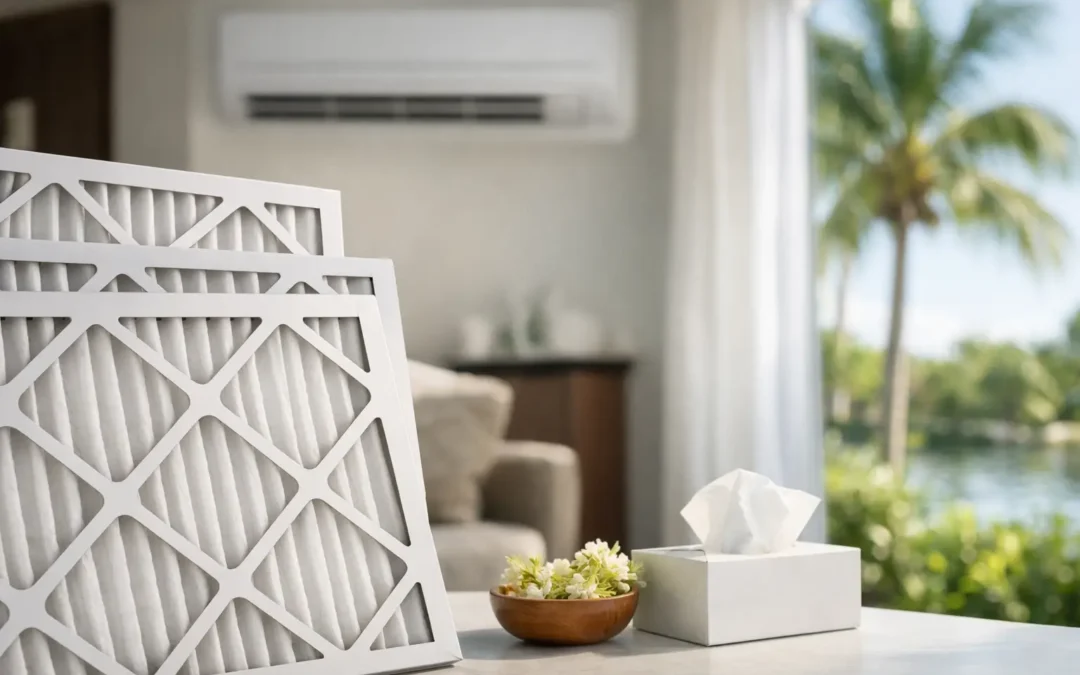
If your allergies seem worse after you get home, your HVAC filter may be part of the problem. In a warm, humid climate, choosing the best air filters for allergies Florida homeowners can actually use comes down to more than grabbing the highest-rated filter on the shelf. You need the right balance of filtration, airflow, humidity control, and system compatibility.
Florida homes deal with a mix of allergens that can make indoor air quality harder to manage. Pollen is a big one, especially when it gets tracked in through open doors, on shoes, or through small air leaks. Dust, pet dander, and mold spores are also common concerns, and mold is where Florida’s climate changes the conversation. High humidity can turn a minor indoor air quality issue into a much bigger comfort and health problem if your system is not filtering and dehumidifying effectively.
That is why the “best” filter is not always the densest or most expensive option. A filter that catches more particles but restricts airflow too much can strain your system, reduce cooling performance, and lead to uneven temperatures. For most homeowners, the best choice is the filter that improves air quality without creating new HVAC problems.
What makes the best air filters for allergies Florida homes need?
The first thing to look at is MERV rating. MERV stands for Minimum Efficiency Reporting Value, and it tells you how effectively a filter captures particles of different sizes. Higher numbers mean finer filtration, but they also usually mean more airflow resistance.
For allergy relief, a basic fiberglass filter is rarely enough. Those low-cost filters are mainly designed to protect the equipment, not improve the air you breathe. They do little for smaller allergy triggers like pet dander, fine dust, and many airborne particles.
A MERV 8 filter is often an improvement over the cheapest options, but it may still fall short for homes with significant allergy concerns. MERV 11 and MERV 13 filters are usually the better range for homeowners looking to reduce allergens indoors. They can capture much smaller particles and offer a noticeable step up in filtration when the system is designed to handle them.
That last point matters. Not every residential HVAC system should use a MERV 13 filter. If your equipment, ductwork, or return air setup is already marginal, a high-efficiency filter can reduce airflow enough to affect performance. In Southwest Florida, where your AC works hard for much of the year, poor airflow can lead to comfort issues and unnecessary wear on the system.
MERV 8 vs. MERV 11 vs. MERV 13
For many Florida homes, MERV 11 hits a practical middle ground. It filters much better than standard entry-level filters while still being manageable for many residential systems. If someone in the home has moderate allergies, pets, or frequent dust problems, this is often a strong place to start.
MERV 13 is usually the better fit when allergies are more severe, indoor air quality is a major concern, or there are added factors like nearby construction, multiple pets, or recurring fine dust. It can capture smaller particles more effectively, but only if the system can maintain proper airflow with that level of filtration.
MERV 8 can still make sense in some homes, especially older systems that struggle with more restrictive filters. It is not the best performer for allergies, but it may be a safer choice than installing a filter so dense that your AC cannot breathe properly. In those cases, the better solution may be improving the overall indoor air strategy instead of relying on the filter alone.
Are HEPA filters the answer?
Homeowners often hear that HEPA is the gold standard, and technically that is true for particle capture. HEPA filters remove extremely fine particles at a very high rate. The catch is that most standard residential HVAC systems are not built to handle true HEPA filtration.
A true HEPA filter is much more restrictive than typical 1-inch return filters. Installing one in a system that was not designed for it can create serious airflow problems. That is why HEPA is more common in portable air purifiers or specialized whole-home systems designed specifically around that level of filtration.
If you want better allergy relief, it is usually smarter to choose the highest MERV rating your HVAC system can safely support rather than forcing a HEPA-style solution into equipment that is not designed for it.
Filter thickness matters more than many homeowners realize
A 1-inch filter and a 4-inch media filter can have very different real-world performance, even at similar efficiency ratings. Thicker filters typically have more surface area, which helps them trap particles while maintaining better airflow over a longer period.
That makes a big difference in Florida, where air conditioners run often and filters collect debris faster. A thicker media filter may last longer, perform more consistently, and put less strain on the system than a high-rated 1-inch filter.
If your current setup only accepts a 1-inch filter, that does not automatically mean you have a problem. It just means filter selection has to be more careful. Going straight to the highest-rated option in a thin filter can sometimes do more harm than good if static pressure climbs too high.
Why Florida humidity changes the filter discussion
When homeowners think about allergies, they usually think about pollen and dust. In Florida, humidity needs to be part of the conversation too. Excess moisture supports mold growth, and mold spores are a major indoor allergen.
An air filter can help capture some mold spores moving through the air, but it does not solve the underlying moisture issue. If your indoor humidity stays high, you may still have allergy symptoms even with a good filter in place. That is why better filtration works best when paired with proper AC performance, clean coils, and good humidity control.
If your home feels clammy, smells musty, or has rooms that never seem to dry out, the filter may not be the main problem. Your system may need maintenance, airflow adjustments, or a more effective dehumidification strategy.
How often should you change allergy filters in Florida?
In many Florida homes, filter changes need to happen more often than the package suggests. Usage is high, outdoor allergens are persistent, and homes with pets or frequent foot traffic tend to load filters faster.
A good rule is to check your filter monthly and expect replacement somewhere between 30 and 90 days, depending on the filter type, system runtime, and indoor conditions. A heavily loaded filter will not just stop helping allergies. It can also reduce airflow and make your HVAC system work harder than it should.
If you notice more dust, weaker airflow, worsening allergy symptoms, or longer AC run times, it is worth checking the filter before assuming something more serious is wrong.
Best air filters for allergies Florida homeowners can choose with confidence
For most residential systems, the best starting point is a pleated filter from a reputable manufacturer in the MERV 11 range. It offers meaningful allergen capture without being overly aggressive for many standard HVAC setups.
If your system has been evaluated and can support it, a MERV 13 filter is often the stronger option for households with more significant allergy concerns. If your system is older or already struggles with airflow, MERV 8 may be the safer fit while you address other indoor air quality improvements.
What you want to avoid is guessing. The best filter on paper is not always the best filter for your specific system. Return grille size, filter thickness, blower capacity, duct condition, and overall system design all affect what will work well in your home.
That is especially true in places like Fort Myers, Cape Coral, and North Fort Myers, where AC systems work through long cooling seasons and indoor comfort depends on keeping airflow and humidity under control.
When a filter alone is not enough
If allergies are persistent even after regular filter changes, it may be time to look beyond the filter. Duct leakage, dirty evaporator coils, poor return air design, and high indoor humidity can all contribute to ongoing air quality problems. In some homes, adding a whole-home air cleaner or indoor air quality accessory makes more sense than simply upgrading to a denser filter.
A professional HVAC inspection can tell you whether your current filter choice is helping, or whether it is covering up a bigger issue. That kind of evaluation is often more valuable than trying multiple filters and hoping one works.
At Infinite Electric & Air, we see this often with homeowners who are doing the right things but still dealing with dust, allergy symptoms, or inconsistent comfort. The issue is not always the filter itself. Sometimes it is the way the whole system is operating.
The right filter should help your air feel cleaner without making your AC work harder than it needs to. If you are unsure what your system can handle, a quick professional check can save you from wasted money, reduced efficiency, and a lot of frustration. Cleaner air starts with the filter, but lasting relief usually comes from making sure the entire HVAC system is set up to support it.