
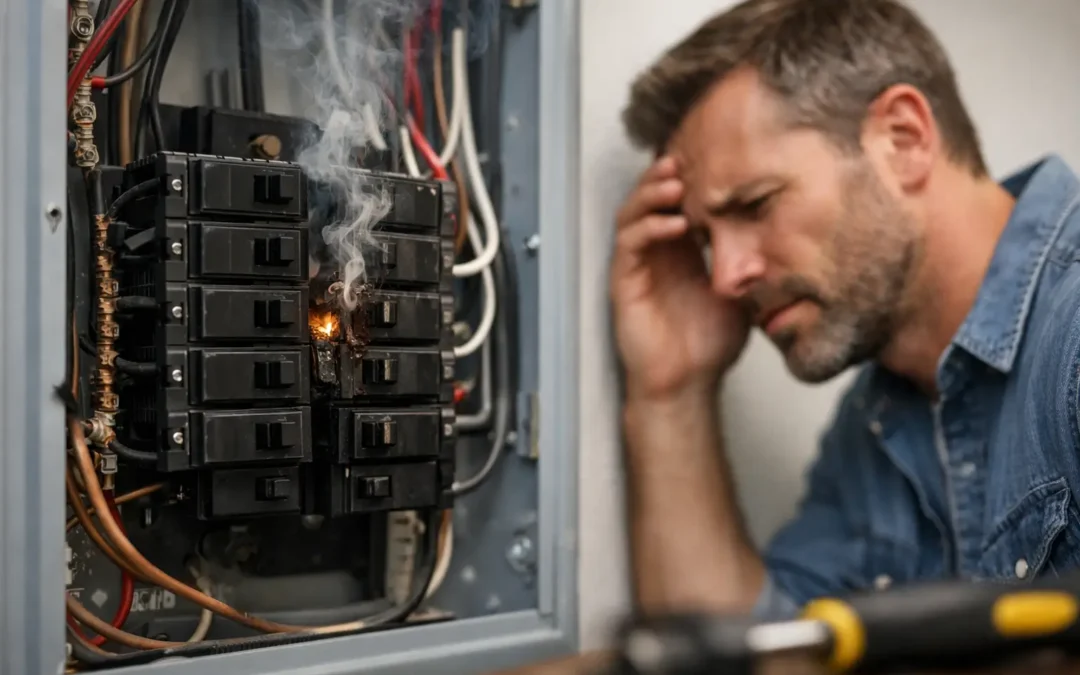
A breaker that trips once after you plug in too many devices is annoying. A breaker that keeps acting up for no clear reason is your home telling you something is wrong. Knowing the signs your circuit breaker is failing can help you catch a safety issue early, before it turns into damaged wiring, ruined appliances, or a real fire risk.
For homeowners in Southwest Florida, this matters even more than people realize. Heat, humidity, storms, and power surges can all put extra stress on your electrical system. If your panel is older, or your home has added appliances over the years, a weak breaker can start showing symptoms long before it completely quits.
What a circuit breaker is supposed to do
Your circuit breaker is a safety device. Its job is to shut off power when a circuit is overloaded, shorting out, or otherwise unsafe. In a healthy electrical system, the breaker trips when it should, resets properly, and keeps electricity flowing reliably the rest of the time.
When a breaker starts to fail, it may trip too easily, fail to trip when it should, or show physical warning signs like heat or burning smells. Some of these symptoms are obvious. Others are easy to brush off as a quirky outlet or an old appliance. That is where homeowners can get caught off guard.
Common signs your circuit breaker is failing
1. It trips repeatedly without a clear cause
A breaker that trips once in a while may be doing its job. For example, if you run a microwave, air fryer, and coffee maker on the same kitchen circuit, a trip makes sense.
The concern is when the breaker trips again and again under normal use. If you have not changed what is plugged in, and the breaker still will not stay on, the breaker itself may be worn out or damaged. It could also point to a wiring issue, so this is not something to keep resetting and ignoring.
2. The breaker will not stay reset
If you flip the breaker off and back on, but it snaps back to the tripped position or shuts off almost immediately, something is wrong. Sometimes that means there is an active short circuit or overload. Other times, the mechanism inside the breaker has simply failed.
Either way, a breaker that will not reset is not a DIY troubleshooting project for most homeowners. The risk is not just inconvenience. It is the possibility of hidden electrical damage behind the panel or in the circuit itself.
3. You smell something burning near the panel
A hot, sharp, burning odor near the electrical panel is one of the most serious warning signs. Breakers can fail internally and overheat. Loose connections can also create heat that damages the breaker and nearby wiring.
If you notice a burning smell, do not keep opening and closing breakers to test them. Leave the area alone as much as possible and call a licensed electrician right away. If there is visible smoke or signs of fire, contact emergency services first.
4. The panel or breaker feels warm or hot
A little warmth can happen in an active panel, especially in a warm garage or utility area. But a breaker that feels noticeably hot to the touch is not normal.
Heat often points to excess current, internal failure, or a poor connection. In Florida homes, high ambient temperatures can make electrical equipment work harder, but heat should never be dismissed as just part of the weather. A breaker should not be overheating during normal household use.
5. You see visible damage
Sometimes the signs are right in front of you. Scorch marks, melted plastic, discoloration, corrosion, or a breaker that looks loose or misshapen are all red flags.
Corrosion is especially worth watching in humid coastal environments. Moisture and salt in the air can shorten the life of electrical components over time. If your panel shows rust or corrosion, the issue may go beyond a single breaker and require a more complete inspection.
6. Lights flicker or power is inconsistent on one circuit
If one room loses power randomly, or lights flicker when a specific appliance turns on, the problem could be tied to a failing breaker. It could also be a loose connection elsewhere, which is why the symptom should be taken seriously either way.
The key is pattern. If the same circuit keeps showing unstable behavior, and it is not tied to a utility outage or storm event, the breaker may not be controlling power properly anymore. That kind of inconsistency can put electronics and appliances at risk.
7. The breaker is old and your electrical needs have changed
Breakers do not last forever. Even if there is no dramatic failure, age matters. An older panel that was installed decades ago may not be a good match for how a modern household uses electricity now.
Large TVs, home offices, garage refrigerators, EV chargers, pool equipment, newer HVAC systems, and whole-home surge protection all add demand. In many homes, the breaker is not failing because of one event. It is failing because the system has been under strain for years.
When it is the breaker and when it is something else
This is where things can get tricky. The signs your circuit breaker is failing can overlap with other electrical problems. A tripping breaker might actually be warning you about damaged wiring, a short in an appliance, a loose neutral, or a circuit that is simply overloaded.
That is why replacing a breaker without proper testing is not always the right fix. If the underlying issue is still there, the new breaker will trip too. A licensed electrician can test the breaker, inspect the panel, and determine whether the real problem is the breaker itself, the circuit, or a larger service issue.
Why homeowners should not ignore these warning signs
A failing breaker is not just an inconvenience. It is a safety problem. If a breaker does not trip when it should, wires can overheat. If it trips erratically, you may lose power to important systems at the worst possible time.
In Southwest Florida, electrical reliability matters year-round. During storm season, homes already face extra stress from surges and interruptions. During the hottest months, your AC system is working hard, and so is the electrical panel supporting it. If a weak breaker is already on the edge, those conditions can push it further.
There is also the appliance side of the equation. Unstable power can shorten the life of refrigerators, electronics, HVAC equipment, and other expensive systems. Catching a breaker problem early can help prevent a much larger repair bill later.
What to do if you notice these signs
Start with the safest step: pay attention to patterns. Notice which circuit is affected, what was running when the issue happened, and whether the symptoms are getting worse.
Do not keep forcing a breaker to reset. Do not ignore burning odors, buzzing sounds, or heat. And unless you are qualified to work inside an electrical panel, do not remove the panel cover or try to replace a breaker yourself. Electrical panels carry serious shock and fire risk.
The smart move is to have the system inspected by a licensed electrician. A professional can determine whether you need a simple breaker replacement, a circuit repair, or a panel upgrade. In some homes, especially older ones, recurring breaker problems are a sign that the panel is undersized or outdated for the home’s current needs.
Signs your circuit breaker is failing versus signs you need a panel upgrade
Sometimes one bad breaker is just one bad breaker. Other times, it is part of a bigger pattern. If multiple breakers are acting up, your panel is outdated, or you are adding major electrical loads to the home, a panel upgrade may make more sense than replacing parts one by one.
This is especially true if your home still has an older electrical panel, you have added new appliances, or you are planning improvements like a generator, EV charger, or upgraded HVAC equipment. A repair can solve the immediate symptom, but it may not solve the long-term capacity issue.
At Infinite Electric & Air, this is one of the most common things we help homeowners sort out – whether the right answer is a targeted electrical repair or a bigger upgrade that improves safety and reliability for years to come.
If your breaker has been giving you warning signs, trust them. Electrical problems rarely get better by themselves, and the earlier you address them, the more options you usually have.