
When a breaker goes bad, the first thing most homeowners want to know is what it will cost. I’m Vinny, and I grew up in a family that has served homes for three generations. I’d rather be straight with you up front than surprise you at the end of the job.
A single breaker swap is a small repair, and it is priced like one. This guide explains what shapes the bill, how to tell whether one breaker is the problem or the whole panel is, and what to do while you wait for help. You won’t find made-up dollar figures here, because an honest price depends on your panel and your circuit.
What a Single Breaker Replacement Covers
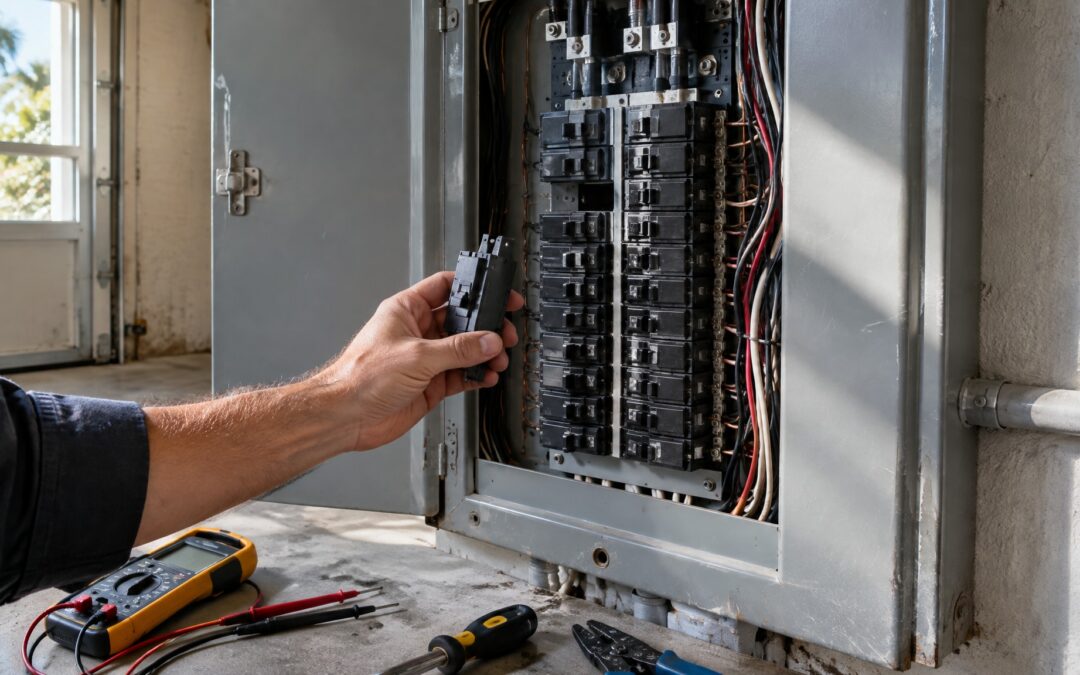
When we replace one breaker, we do four things. We diagnose it, match it to your panel, swap it, and test the circuit afterward.
Diagnosis comes first because a breaker that trips is not always a breaker that has failed. Sometimes the breaker is doing its job and something on the circuit is the real trouble. We confirm that before we put a new part in your panel.
Matching is next. The new breaker has to be the right type and rating, and it has to be made for your specific panel, so we don’t grab whatever is closest on the truck.
Then we swap it and test the circuit under load, which lets us confirm the problem is gone before we leave your driveway.
That is why the price follows the breaker type, how easily we can reach the panel, and how long the diagnosis takes, rather than a flat fee.
What Drives Circuit Breaker Replacement Costs in Florida
Every breaker job looks similar from the outside, but the details underneath move the labor. The two biggest pieces are the breaker itself and the time it takes to find and fix the cause.
Next to a full panel replacement, a single swap is a small job. Even so, I won’t quote a number I can’t stand behind, and no honest electrician can name a firm price before seeing your panel.
Breaker Replacement Price by Breaker Type
A like-for-like standard breaker is the simplest and least expensive case. It protects an ordinary circuit, and swapping it takes little time once we’ve confirmed it is the culprit.
GFCI and AFCI breakers cost more, and they do different work. A GFCI breaker guards against ground faults, which matters where water is near, such as kitchens, bathrooms, garages, and outdoor outlets. An AFCI breaker watches for arcing in the wiring, which is why code often calls for it on bedroom and living-area circuits.
The right type depends on where the circuit runs in your home, so you can’t always replace a failed breaker with the cheapest one on the shelf. If the circuit is in a location where the code calls for GFCI or AFCI protection, the new breaker needs to provide it. That is a safety matter first and a cost matter second.
Diagnostic Time, Panel Access, and Timing
Finding the fault takes time, and that time shows up in the labor. A clean, obvious failure is quick, while a breaker that trips for reasons we have to track through the wiring takes longer.
Older panels add another wrinkle. A matching breaker for a discontinued or unusual panel can take real effort to source, and that effort affects the visit. Cramped or blocked panel locations, such as a panel behind shelving in a garage, slow the work too.
Timing matters as well. After-hours calls and storm-season rushes cost more to staff than a routine weekday visit, and during hurricane season, everyone in Southwest Florida needs an electrician at once.
If you can clear the area around your panel before we arrive, you save us time and you save yourself some of the bill.
When One Breaker Swap Is Enough
One failed breaker on one circuit is usually a straight swap. The rest of the panel is fine, the other circuits behave, and the fix is a new breaker.
The trick is knowing whether the breaker is the problem or just the messenger. Here is how I think it through with homeowners.
Bad Circuit Breaker Signs to Watch For
A breaker that needs replacing often tells you so. These are the bad circuit breaker signs I look for first:
- It feels warm or hot to the touch.
- You see scorch marks or discoloration around it.
- It buzzes or hums.
- It won’t hold in the “on” position.
- It fails to trip when the circuit is clearly overloaded.
That last one worries me most, because a breaker that doesn’t trip can’t protect your wiring. Older panels from makers such as Federal Pacific and Zinsco have a widely reported history of breakers that fail to trip when they should.
Our coastal air plays a part too. Salt and humidity can corrode breaker terminals and panel connections, so a breaker that runs warm or looks discolored may point to corrosion as well as a worn-out switch. If I see corrosion, I look past the one breaker to the connections around it.
When a Tripped Breaker Keeps Tripping
A tripped breaker that keeps tripping is a different story, because a new breaker may not change anything. Repeat trips usually come from the circuit, not the breaker. The circuit may be overloaded, there may be a short, or an appliance may be failing.
An air conditioner is a common cause here in Southwest Florida. If the breaker for your AC trips again and again, the unit may be drawing too much current, and the guide on an AC that runs but won’t cool covers the usual causes. Swapping the breaker in that case would only hide a problem that is still there.
A sound breaker can also trip under a heavy continuous load. Electrical rules treat a load that runs for hours as a different animal from a brief spike, and a breaker is generally not meant to carry its full rating nonstop. A space heater, a pool pump, or a large appliance on a shared circuit can trip a perfectly good breaker. Your electrician should check the load, not just the breaker.
Lights that dim or flicker along with the trips are another clue. Flickering lights that point to a circuit problem can mean a loose connection or an overloaded circuit, and neither one is fixed by a new breaker.
A swap won’t cure a fault in the wiring or an appliance. Anyone who offers to replace a breaker that keeps tripping without looking at the circuit is guessing with your money.
When a Full Panel Replacement Makes More Sense
Sometimes the breaker is only the first thing to fail. When the trouble spreads, I’d rather tell you so than keep swapping parts.
Age alone doesn’t settle the question. A well-kept older panel can serve a home for years, and a newer panel can still be damaged. What I look at is condition and capacity. Here we keep to the decision, and for pricing, our guide to full panel upgrade costs in Florida goes into it.
Signs the Panel, Not the Breaker, Is the Problem
These point to the panel:
- Breakers failing on several circuits, not just one.
- Corrosion or scorching inside the panel.
- A known problem brand, such as the Federal Pacific and Zinsco panels mentioned above.
- No open slots for circuits you need, such as a new mini-split, EV charger, or kitchen addition.
If you’ve already replaced a breaker or two in the last couple of years and another one is acting up, that pattern matters. It suggests the panel itself deserves a full evaluation, not another patch.
Safe Steps to Take While You Wait for an Electrician
A breaker problem can feel like an emergency even when it isn’t, so a few simple rules keep you and your family safe until we arrive.
Stop resetting a breaker that keeps tripping. Each reset sends current into a circuit that already has a problem, and that can make the fault worse.
Don’t open the panel cover, and stay clear of any breaker that feels warm or looks scorched. Even a quick look inside can expose you to live parts.
If a single outlet has simply gone dead, check the basics first. Our guide on troubleshooting a dead outlet before you call walks you through the safe checks, such as looking for a tripped GFCI.
Smoke, sparking, or flames mean you should leave the home and call 911.
A burning smell without visible smoke is urgent, but not a reason to wait until morning. For that, after-hours electrical emergency help in Naples and the rest of our service area is a phone call away.
What Florida’s Electrical Code Means for a Breaker Swap
Florida’s electrical rules come through the Florida Building Code, which is built on the National Electrical Code. In plain terms, that means the new breaker must be listed for the panel it goes into. Licensed electricians insist on this, because a mismatched breaker may not seat or connect reliably, and a loose connection inside a panel is how fires start.
GFCI or AFCI protection also applies where the location requires it. If your failed breaker serves a bathroom, a garage, or a bedroom, the replacement may need to include that protection even if the old one didn’t.
You’ll see the difference when you compare quotes. A cheaper offer that uses a generic breaker, not one listed for your panel, isn’t really the same job. This is also one more reason to understand why licensing matters for breaker work.
Permits and Inspections for Breaker Work
A like-for-like breaker swap is often treated as routine repair. Panel work, by contrast, almost always needs a permit and an inspection.
The city or county building department has the final say, and rules differ between Fort Myers, Cape Coral, Naples, Estero, and the unincorporated areas around them. If you’re unsure, ask your electrician who pulls the permit and whether this job needs one. This is general information, not legal advice, so your local building department is the place to confirm.
How to Choose a Licensed Electrician in Southwest Florida
Choosing an electrician is a trust decision, and I know you’re reading reviews and asking neighbors before you call anyone. That is exactly how it should work.
Infinite Electric & Air is a licensed electrical and HVAC contractor serving Fort Myers, Cape Coral, Naples, Estero, and the wider Southwest Florida region. We carry a 4.9 Google rating, and I’d like you to read what our neighbors say, not just take my word. If you want licensed electrician services in Fort Myers, that page is the best place to start.
I run this company on a simple standard: honest technicians and personal care, with no sales pressure. We call it Leading with Love, and it shapes how we treat every home.
Electrician Breaker Repair Near You: Questions to Ask First
Whether you call us or someone else, these questions will tell you a lot:
- Are you licensed by the state of Florida? Ask for the license number and check it yourself.
- Will you diagnose before you replace anything? The answer should be yes, because a breaker that keeps tripping often isn’t the real problem.
- Can I have an itemized estimate? It should break out diagnosis, parts, and labor so you can compare quotes fairly.
- Who pulls the permit, if one is needed? A clear answer here shows the electrician knows the local rules.
- What warranty do you offer? Ask for it stated plainly, on the paperwork.
An electrician who answers all five without hesitation is worth your time. One who dodges them is telling you something too.
If a breaker in your home is warm, tripping, or just worrying you, give Infinite Electric & Air a call. We’ll come out fast to Fort Myers, Cape Coral, Naples, or Estero, check your breaker honestly, and tell you plainly whether it’s a simple swap. There is no pressure, only care for your family and your home.
Frequently asked questions
How much should it cost to have a breaker replaced?
The price follows the breaker type, how easy the panel is to reach, and how long the diagnosis takes. A standard like-for-like breaker is the simplest case, while GFCI and AFCI breakers cost more. A single swap is a small job next to a panel replacement, and an honest firm price comes after the electrician sees your panel.
What is the 80% rule for electrical panels?
The 80% rule says a breaker should not carry more than 80% of its rating as a continuous load, meaning a load that runs for three hours or more. A 20-amp circuit, for example, should carry no more than 16 amps continuously. It is why a sound breaker can trip under a space heater or pool pump, and why the electrician should check the load.
Do you need a permit to replace an electrical panel in Florida?
Panel replacement almost always needs a permit and an inspection. A like-for-like breaker swap is often treated as routine repair, but the city or county building department has the final say. Ask your electrician who pulls the permit before work starts.
Should a 50-year-old electrical panel be replaced?
Age alone doesn’t decide it. Condition and capacity do: breakers failing on several circuits, corrosion or scorching inside the panel, a known problem brand, or no open slots for circuits you need all point toward replacement. A licensed electrician can inspect the panel and tell you plainly whether it still has good years left.