
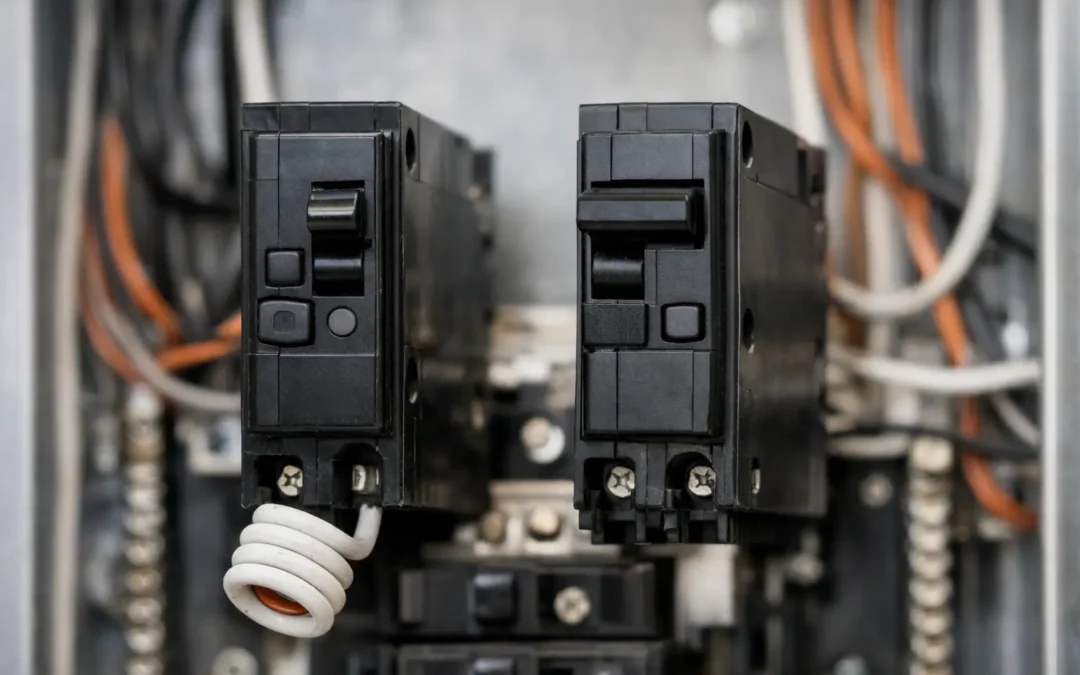
A tripped breaker can be frustrating, but a GFCI vs AFCI breaker decision is about far more than preventing nuisance trips. These two safety devices watch for different electrical hazards inside your home. Choosing the right one, and having it installed correctly, helps protect your family, wiring, and appliances from risks that an ordinary circuit breaker may not detect.
For Southwest Florida homeowners, that distinction matters. Moisture around kitchens, bathrooms, lanais, garages, and outdoor equipment raises the risk of electrical shock. Meanwhile, aging wiring, damaged cords, loose connections, and overloaded circuits can create dangerous arcing conditions behind walls.
What a GFCI Breaker Protects Against
GFCI stands for ground-fault circuit interrupter. A GFCI breaker is designed primarily to reduce the risk of electrical shock.
It continuously compares the electricity flowing out on the hot wire with the electricity returning on the neutral wire. Under normal conditions, those amounts should match. If some current takes an unintended path, such as through water, a damaged appliance, or a person, the device senses the imbalance and shuts off power quickly.
That rapid shutoff is why GFCI protection is commonly required in areas where water and electricity are more likely to meet. In a typical home, that can include bathrooms, kitchen countertop circuits, garages, laundry areas, unfinished spaces, outdoor outlets, pool-related equipment, and certain other locations depending on the current electrical code and the home’s layout.
A GFCI breaker protects the entire circuit it serves. That differs from a GFCI receptacle, which protects itself and may protect other outlets connected downstream. Both can be appropriate solutions, but a licensed electrician should determine which arrangement makes the most sense for the circuit and panel.
What an AFCI Breaker Protects Against
AFCI stands for arc-fault circuit interrupter. An AFCI breaker is intended to help prevent electrical fires caused by hazardous arcing.
An arc occurs when electricity jumps across a gap instead of traveling through a solid, intended connection. Small arcs can occur for several reasons: a loose wire connection, a nail or screw that damages wiring behind drywall, a worn extension cord, a failing appliance cord, or deteriorated insulation. Some arcs generate enough heat to ignite nearby materials, even when the breaker does not see the level of current needed to trip for an overload or short circuit.
An AFCI breaker uses electronic sensing to recognize patterns associated with dangerous arcing and disconnects the circuit when it detects a problem. It is not simply looking for too much current. It is looking for the electrical signature of an arc.
AFCI protection is commonly used on circuits serving living areas, bedrooms, hallways, closets, and similar spaces. Requirements can vary based on the age of the home, the scope of a renovation, and the electrical code in effect for the project. That is one reason electrical upgrades should not be based on a one-size-fits-all checklist.
GFCI vs AFCI Breaker: The Key Difference
The simplest way to understand a GFCI vs AFCI breaker is to focus on the hazard each one is designed to address. A GFCI helps protect people from shock caused by current going where it should not. An AFCI helps protect the home from fire caused by dangerous arcing in wiring or cords.
Neither device replaces the other. A GFCI may trip when a wet appliance or damaged cord leaks current to ground, but it may not respond to an arcing connection in the same way an AFCI does. An AFCI may detect a loose connection that is sparking inside a wall, but it is not a substitute for ground-fault protection near water.
Standard circuit breakers still have a separate job. They protect wiring from overcurrent conditions, such as an overload or direct short circuit. Modern electrical safety often calls for more than one layer of protection because electrical hazards do not all look the same.
Can One Breaker Provide Both Protections?
Yes. Dual-function breakers combine GFCI and AFCI protection in a single device. They can be a practical solution when a circuit requires both types of protection or when a panel upgrade is being planned.
For example, some areas of a home may need ground-fault protection because of their proximity to water while also requiring arc-fault protection under current code rules. A dual-function breaker can cover both needs without adding separate devices in the same circuit path.
However, compatibility matters. Breakers are not universal parts. A breaker must be listed and approved for the specific electrical panel model. Installing a breaker that merely appears to fit can create poor connections, overheating, unreliable operation, or code concerns. This is not a safe place to mix brands or experiment with parts from a hardware store.
Why These Breakers Trip
A GFCI or AFCI trip is not automatically proof that the breaker has failed. The breaker may be doing exactly what it was designed to do. Still, repeated trips deserve attention rather than repeated resets.
A GFCI breaker may trip because of moisture in an outdoor outlet, a failing refrigerator or washing machine, a damaged cord, a problem with pool or landscape equipment, or a wiring issue on the circuit. In Florida, humidity, wind-driven rain, and corrosion can all contribute to problems around exterior electrical components.
An AFCI breaker may trip because of a loose outlet connection, a damaged lamp or appliance cord, aging wiring, an improperly wired neutral, or certain electronic equipment. Occasionally, an older appliance or power tool can create electrical noise that requires professional troubleshooting. The right response is not to replace the AFCI with a standard breaker. The right response is to identify why the device is detecting a condition.
If a breaker trips immediately after being reset, if you smell burning, see discoloration at an outlet, hear buzzing, or notice warm switches or receptacles, leave the circuit off and call a licensed electrician promptly.
Testing GFCI and AFCI Protection
Most GFCI and AFCI breakers have a test button. Pressing it should trip the breaker and shut off power to the protected circuit. Afterward, move the handle fully to the OFF position if needed, then reset it to ON.
Homeowners can perform the built-in test periodically, following the manufacturer’s instructions. A test button is useful, but it is not a complete diagnosis of the circuit or every connected device. If the breaker will not reset, does not trip when tested, or trips repeatedly, professional inspection is the safer next step.
Avoid testing electrical equipment with improvised methods, such as introducing water near an outlet or trying to create an arc. Those methods can cause injury, equipment damage, or a fire.
When an Electrical Upgrade May Be Needed
Older homes may have panels or circuits that predate modern GFCI and AFCI requirements. That does not always mean every existing circuit must be immediately rebuilt. Requirements often depend on whether you are replacing equipment, remodeling, adding circuits, or upgrading a panel.
Still, an older electrical system deserves a closer look when you are planning a kitchen renovation, adding a garage refrigerator, installing a pool pump, upgrading HVAC equipment, or experiencing frequent breaker trips. These projects can change electrical loads and reveal weaknesses that were previously hidden.
A panel evaluation can identify concerns such as limited capacity, corrosion, outdated components, improper breaker types, double-tapped wiring, or insufficient protection in high-risk areas. At Infinite Electric & Air, our licensed electricians help homeowners understand what their panel needs, explain options clearly, and provide transparent recommendations based on safety and the scope of the work.
The Safer Choice Is the Correct One
GFCI and AFCI breakers are not competing upgrades. They are two different tools for two different risks. The best choice depends on the circuit’s location, what it powers, the age and condition of the electrical system, and the requirements that apply to your project.
If a breaker keeps tripping or you are unsure whether your home has the right protection, treat that uncertainty as a reason to have the circuit checked. A careful electrical inspection can turn a confusing panel issue into a clear, practical plan for a safer home.