
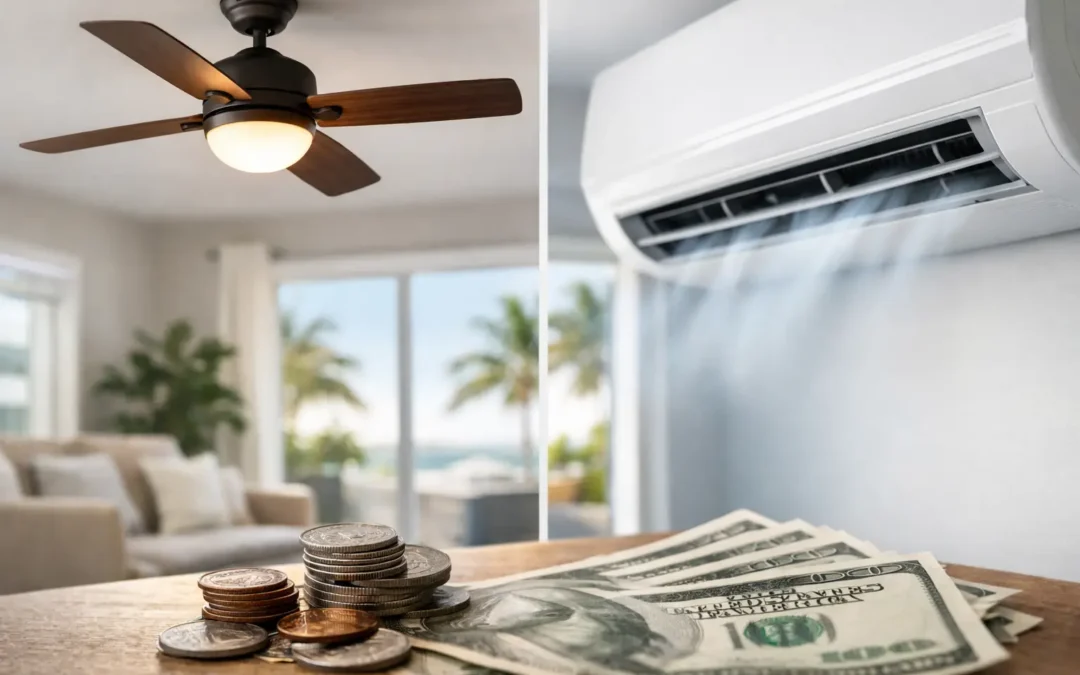
A ceiling fan can make a 78-degree room feel more comfortable without changing the temperature on the thermostat. That difference is the heart of ceiling fan vs AC savings for Southwest Florida homeowners: fans cost far less to run, but they cannot replace the cooling and humidity control your air conditioner provides.
Used together, a properly sized ceiling fan and a well-maintained AC system can reduce unnecessary cooling costs while keeping rooms comfortable through long, humid Florida afternoons. Used the wrong way, such as leaving fans running in empty rooms or raising the thermostat too high, the savings can disappear quickly.
Ceiling Fan vs AC Savings: The Basic Difference
A ceiling fan uses electricity to move air across your skin. That airflow speeds up the evaporation of perspiration and creates a wind-chill effect, making you feel cooler. It does not remove heat from the room. In fact, the fan motor adds a small amount of heat while it runs.
An air conditioner does much more demanding work. It pulls heat from indoor air, moves that heat outside, and removes moisture as air passes over the indoor coil. In North Fort Myers, Cape Coral, and nearby communities, that moisture removal matters as much as lower temperature. A home can feel sticky and uncomfortable even when the thermostat reading is relatively low.
The electricity difference is substantial. Many ceiling fans use roughly 15 to 100 watts depending on their motor, speed, and age. A central air conditioner can draw several thousand watts while running. That is why a fan is inexpensive to operate, while AC runtime is usually one of the largest contributors to a summer electric bill.
Still, the comparison is not fan instead of AC. The practical choice is usually fan with AC, so the thermostat can be set a little higher without sacrificing comfort.
How Fans Can Reduce Air Conditioning Costs
When a ceiling fan is running in an occupied room, many homeowners can comfortably raise the thermostat by a few degrees. The exact number depends on humidity, clothing, activity level, insulation, sun exposure, and personal preference. Even a modest adjustment can reduce how often the AC needs to cycle.
For example, a family that prefers 74 degrees may find that 76 or 77 degrees feels comfortable in the living room with a fan creating steady airflow. The AC still cools and dehumidifies the home, but it does not have to maintain the lower setting all day.
The savings are greatest when the thermostat change is realistic. Setting it from 72 to 78 may work for some people, but not for every household or every room. Bedrooms, kitchens, home offices with electronics, and rooms with direct afternoon sun can have very different comfort needs.
A fan also helps reduce hot and cold spots. If the upstairs bedroom feels warmer than the main living area, airflow can improve comfort before you assume the entire system needs a lower thermostat setting. However, a persistent temperature imbalance can also point to an HVAC issue, undersized ductwork, poor attic insulation, leaky ducts, or an AC system that needs service.
Turn Fans Off When the Room Is Empty
This is the rule that matters most. Ceiling fans cool people, not rooms. Leaving a fan running in an empty bedroom does not help the air conditioner cool that room. It only adds electricity use and a small amount of motor heat.
Use the wall switch, remote, timer, or smart control to turn off fans when people leave. In frequently used spaces, a timer can be especially helpful at bedtime or when leaving for work.
Use the Right Direction and Speed
During cooling season, ceiling fans should generally rotate counterclockwise when viewed from below. This pushes air downward and creates the breeze effect you want. Use the lowest speed that keeps you comfortable. Higher speed can be useful on very warm days, but it also creates more noise and uses more power.
In winter, many fans can run clockwise at a low speed to circulate warm air near the ceiling without creating a draft. Florida winters are mild, but this setting can still help on cooler nights.
Why a Ceiling Fan Cannot Replace AC in Florida
Florida heat is only part of the challenge. Humidity is the other factor. Air conditioning removes moisture from indoor air, which supports comfort and helps protect the home from conditions that encourage mold growth, musty odors, and condensation problems.
A ceiling fan cannot lower indoor humidity. It may make a humid room feel better while someone is sitting beneath it, but the air itself remains humid. If the AC is off for extended periods during hot, wet weather, fans alone will not protect indoor comfort or moisture levels.
This is particularly relevant for vacant homes, seasonal residences, and rooms that stay closed for long periods. The goal in those situations is not simply to feel cooler. It is to maintain reasonable temperature and humidity conditions throughout the home.
Fans also cannot solve a failing AC system. If your system is blowing warm air, short-cycling, freezing up, leaking water, or struggling to keep up with normal demand, adding more fan speed only masks the problem temporarily. Prompt HVAC service can prevent a small repair from becoming a more expensive breakdown during peak cooling season.
Get More Savings From the System You Already Have
Ceiling fan vs AC savings depend heavily on the condition of the rest of the home. A fan can support efficiency, but it cannot overcome clogged filters, poor airflow, or a system that has not been maintained.
Start with the basics: use the correct air filter and replace it on schedule, keep supply vents open and unobstructed, and make sure outdoor equipment has clear space around it. Closing too many vents can increase resistance in the duct system and create comfort problems rather than savings.
Annual AC maintenance is also valuable in Southwest Florida because cooling systems work hard for much of the year. A professional visit can identify dirty coils, drainage concerns, worn electrical components, refrigerant issues, and airflow problems before they affect comfort or reliability.
Window coverings can make a noticeable difference in rooms that receive direct sun. Closing blinds or shades during the hottest part of the day reduces solar heat gain, so the AC and fan have less heat to manage. Weatherstripping around exterior doors and properly sealed ductwork can help for the same reason.
If your ceiling fan is old, noisy, wobbly, or uses a pull chain that no longer works correctly, replacement may be worthwhile. Modern fans with efficient DC motors often use less energy and offer more speed control. Just as important, the fan must be securely mounted to a fan-rated electrical box. A standard light-fixture box is not designed to support a moving ceiling fan.
When an Upgrade Makes Sense
A new fan is a sensible upgrade when the current fan is poorly sized for the room, does not move enough air, or has an unsafe or unstable installation. Bigger is not always better, though. Blade span, ceiling height, room layout, and mounting location all affect performance.
An AC upgrade deserves a closer evaluation when repair costs are increasing, humidity remains high, comfort varies significantly from room to room, or the system cannot keep up despite proper maintenance. High-efficiency equipment can reduce energy use, but correct sizing and installation are just as important as the efficiency rating. An oversized system may cool quickly but run short cycles, which can reduce humidity control.
For electrical safety, have a licensed professional inspect any fan that shakes, makes grinding sounds, trips a breaker, smells hot, or has damaged wiring. Those are not issues to solve with a tighter bulb or a new remote.
The most useful approach is simple: let the AC handle heat and humidity, then let ceiling fans make occupied rooms comfortable at a higher thermostat setting. If your home still feels uneven, muggy, or expensive to cool, Infinite Electric & Air can help identify whether the issue is airflow, equipment performance, electrical safety, or a combination of all three.