
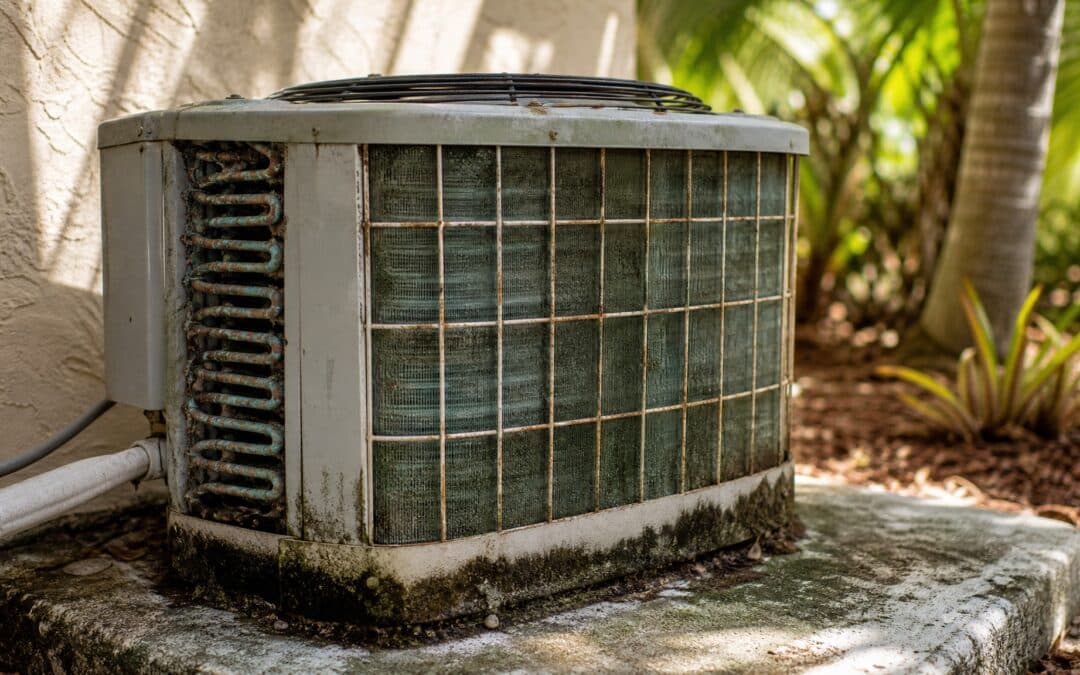
Living in Southwest Florida means your air conditioner works harder than almost any other appliance in your home. We don’t just cool our houses for a few summer months. We battle humidity and heat nearly year-round from Cape Coral to Naples, and that constant demand changes how equipment ages and what failure actually looks like.
Generic national advice often misses these regional realities completely. You need to judge your system by local stress factors, not arbitrary timelines designed for milder climates. Knowing the specific signs you need a new AC unit here prevents emergency breakdowns during our most brutal weather.
Why Southwest Florida Homes Wear Out AC Units Faster
Your air conditioner faces environmental challenges that simply don’t exist in most of the United States. Coastal salt air in Fort Myers and Naples speeds up condenser coil corrosion, a common failure point that shortens AC lifespan compared to inland installations. This chemical degradation happens silently long before mechanical parts begin to fail.
Continuous operation also wears equipment out faster. While northern units might run two thousand hours a year, SWFL systems frequently run more than double that. Components cycle constantly under high latent loads, so they exhaust their engineered service life years ahead of schedule.
High ambient humidity piles onto every mechanical stressor. Moisture gets into electrical connections, feeds biological growth inside ductwork, and forces compressors to work harder removing latent heat from the air. Local homeowners need to judge replacement needs by these pressures, not by generic guidelines written for drier climates.
Your Energy Bills Keep Climbing Despite Maintenance
Watching your monthly electric bill rise is frustrating when you’ve maintained your system faithfully. Unexplained increases often signal declining compressor efficiency or refrigerant issues rather than simple utility rate adjustments. Your equipment may still produce cold air while pulling significantly more power to get there.
Distinguishing Rate Hikes from Efficiency Loss
Compare your current kilowatt-hour usage against the same billing period from previous years to isolate true efficiency loss. If consumption has jumped fifteen percent or more without a matching rate increase, your system is probably failing internally. Aging compressors and worn motors draw excess amperage even when the cooling output still looks fine.
When SEER Ratings No Longer Match Florida Standards
Older units installed before current minimum efficiency standards struggle hard with our climate demands. Equipment rated below modern SEER requirements costs a lot more to run during our long cooling seasons. Replacing an outdated system often pays for itself through lower energy bills within just a few years of Florida operation.
You deserve honesty about whether repair spending makes financial sense given your unit’s baseline inefficiency. Honest contractors calculate actual operating cost differences rather than pushing upgrades you don’t need. Sometimes the math clearly favors replacement over continued repair bills.
Frequent Repairs Are Costing More Than Replacement
Repair bills pile up fast once equipment reaches its final stretch. Homeowners in Cape Coral often see repair frequency spike after year eight, driven by continuous compressor cycling in our tropical climate. Each fix buys temporary relief while the underlying deterioration keeps going.
Applying the Repair-Versus-Replace Rule Locally
Multiply your unit’s age by the estimated repair cost to gauge whether replacement makes better financial sense. When that product tops five thousand dollars in our market, new equipment typically offers better long-term value. This threshold accounts for Florida’s higher annual runtime and faster depreciation.
Consider looking at mini-split vs central air options if your current ducted system needs extensive repairs. Zoned solutions sometimes give better comfort and efficiency in homes where central air struggles. The right choice depends on your layout and how you actually use the space.
Common Old AC Unit Problems in Humid Climates
Recurring capacitor failures point to broader electrical degradation in salt-laden environments. Corroded evaporator coils leak refrigerant repeatedly no matter how many times you patch them. Chronic drain line clogs suggest biological contamination that cleaning alone won’t permanently fix.
These symptoms cluster together as equipment nears end-of-life. Preventive AC maintenance plans help extend serviceable life, but they can’t reverse component exhaustion that’s already happened. Knowing the difference saves you money wasted on temporary fixes for terminal problems.
Uneven Cooling and Persistent Humidity Indoors
Comfort problems often stick around even when your thermostat reads the right temperature. Proper dehumidification matters as much as cooling in SWFL. Units that can’t handle the latent load leave your home sticky even when the setpoint is met, because temperature alone doesn’t define real comfort in our climate.
Hot Spots That Signal Ductwork or Capacity Issues
Rooms that stay warm despite decent airflow point to undersized equipment or leaking ductwork. If your system is running but not cooling the whole house evenly, the original capacity calculations may be wrong. Sizing done years ago often doesn’t account for renovations, added insulation, or more people living in the house now.
Duct leakage wastes cooled air before it ever reaches your living spaces. Sealing and testing should come before any replacement decision, to rule out a distribution problem first. Sometimes fixing the delivery system solves the comfort complaint without new equipment at all.
Why Your Home Still Feels Sticky at 72 Degrees
Oversized units cool the air too quickly to pull out adequate moisture. Short cycling keeps the evaporator coil from ever reaching proper dehumidification temperatures, so your home feels clammy even though the thermometer looks fine.
Undersized equipment runs nonstop yet never hits target humidity levels either. Both problems point to a capacity mismatch that repairs can’t fix. A proper load calculation, using Manual J protocols, is essential before you pick replacement equipment for an SWFL home.
Unusual Noises, Odors, or Constant Running
Strange sounds and smells need immediate professional attention in our humid environment. Grinding noises mean a bearing is failing, and that can seize a compressor without warning. Squealing belts or metal-on-metal contact means mechanical breakdown is close.
Musty odors often mean mold is growing inside the ductwork or air handler. That’s a health risk, not just a discomfort, especially for anyone in the house with respiratory issues. Nonstop operation points to refrigerant loss, a failing thermostat, or a capacity deficiency severe enough to strain every component.
These symptoms rarely clear up with a simple adjustment or a swapped part. They’re systemic failures that compromise safety and comfort both. Waiting invites more expensive damage, or a health hazard, in Florida’s moisture-heavy air.
None of this applies to minor quirks or normal seasonal startup adjustments. It’s about the signs that threaten your home’s habitability and your family’s wellbeing.
Your AC Unit Is Approaching or Past Its Florida Lifespan
National averages suggesting fifteen to twenty-year service lives mislead Southwest Florida homeowners. Our continuous cooling cycles and corrosive coastal environment compress that timeline a lot. Expecting northern longevity here leads to unplanned emergency replacements during peak demand.
Typical AC Unit Lifespan in Southwest Florida
Most residential systems in our region reach functional end-of-life between ten and fifteen years. Units that get meticulous maintenance sometimes stretch toward eighteen, but performance drops off noticeably after year ten. Planning around this realistic window, instead of a national average, avoids crisis decisions made under pressure.
Budgeting for replacement before a catastrophic failure gives you negotiating power and scheduling flexibility. Emergency replacements during a July heat wave cost more and leave you with fewer equipment choices. Timing it yourself turns a stressful necessity into a managed home improvement project.
How Salt Air and Storm Exposure Shorten Service Life
Coastal properties face corrosion that inland installations never deal with. Salt spray eats through aluminum fins and copper tubing no matter how well you maintain the unit. Hurricane exposure adds water intrusion and debris damage that compromises the equipment permanently.
Storm surge history matters even for elevated equipment. Past flooding may have damaged electrical components that keep working, marginally, while deteriorating from the inside. A professional inspection after a major storm catches hidden damage before it turns into complete failure.
Getting an Honest AC Replacement Estimate in SWFL
Finding trustworthy guidance matters as much as finding competent installation. Infinite Electric & Air serves SWFL homeowners with honest assessments rooted in third-generation trade experience, and a 4.9 Google rating built on trust rather than sales pressure. We believe leading with love means telling you the truth even when it doesn’t lead to immediate revenue.
A proper consultation includes a detailed load calculation, a ductwork evaluation, and transparent pricing without hidden fees. Ask about equipment warranties, installation guarantees, and what support looks like after the install. Knowing how to go about choosing a trustworthy HVAC contractor protects you from high-pressure tactics and inflated quotes.
Your free estimate should feel educational, not transactional. We want you to understand your options fully before you commit to anything. Schedule your no-pressure assessment today and see what honest, locally informed AC replacement guidance actually looks like for your Southwest Florida home.
Frequently Asked Questions About AC Replacement
How do I know if my HVAC needs to be replaced?
Look for rising energy bills despite maintenance, frequent repairs exceeding $500 annually, uneven cooling with persistent humidity, and unusual noises or odors. In Southwest Florida, units older than ten years warrant proactive evaluation regardless of current performance. A licensed contractor can perform load calculations and efficiency tests to confirm whether repair or replacement serves your best interest.
What is the 5x rule for air conditioning replacement?
Multiply your unit’s age by the repair cost estimate to determine if replacement makes financial sense. When the product exceeds $5,000 in SWFL markets, new equipment typically offers better long-term value than continued repairs. This formula accounts for our region’s accelerated wear patterns and higher annual operating hours compared to national averages.
Why does my AC run constantly but my house still feels humid?
Oversized units cool too quickly to remove adequate moisture, while undersized equipment never reaches proper dehumidification temperatures. Both scenarios create sticky conditions despite acceptable thermostat readings. Proper Manual J load calculation identifies whether your current system matches your home’s actual latent and sensible cooling requirements.
What is the 3-minute rule for air conditioners?
Wait three minutes after shutdown before restarting your AC to prevent compressor damage from pressure imbalances. Modern thermostats include built-in delays, but manual overrides or older controls may bypass this protection. Frequent short cycling without adequate rest periods accelerates wear and indicates underlying system problems requiring professional diagnosis.