
If one room in your home always feels muggy while the rest of the house is freezing, you are already asking the right question: ducted vs ductless mini split. For Southwest Florida homeowners, that choice is not just about equipment style. It affects humidity control, appearance, installation cost, long-term efficiency, and how comfortable your home feels in the middle of a long summer.
Mini split systems have become a practical option for homes that need better cooling without the expense or disruption of a full traditional ducted system. But there is more than one way to use them. Some mini split systems deliver air through short duct runs hidden in ceilings or soffits. Others send conditioned air directly into the room through wall-mounted, floor-mounted, or ceiling-mounted indoor units. Both can work well. The better choice depends on your layout, your comfort priorities, and how you want the finished space to look.
Ducted vs ductless mini split: the core difference
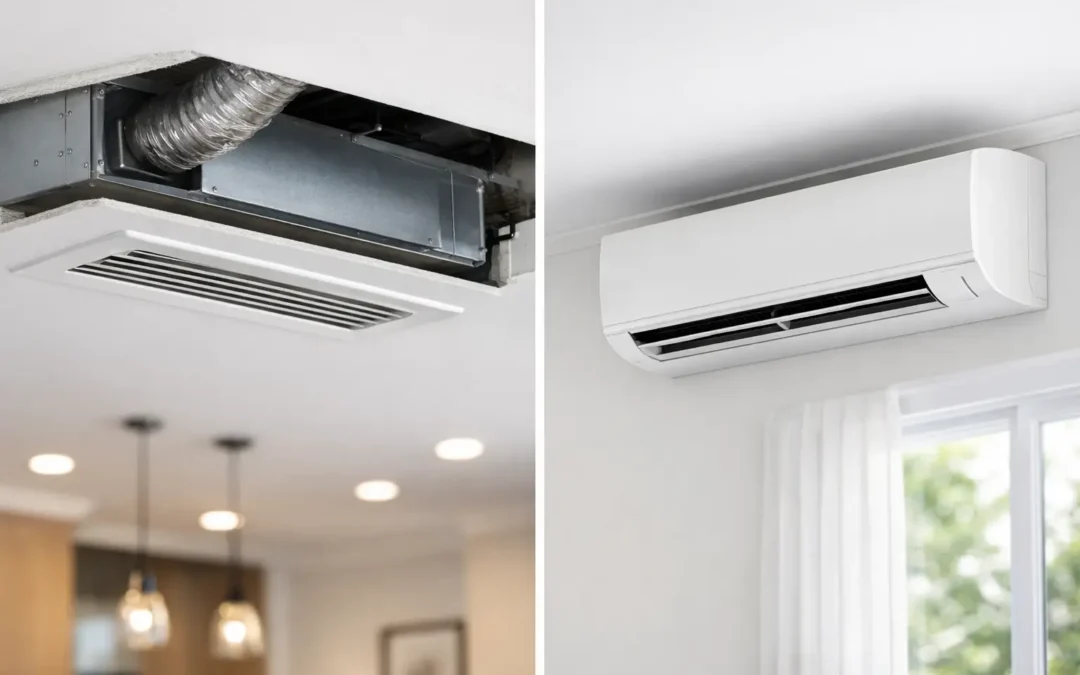
A ductless mini split uses an outdoor unit connected to one or more indoor air handlers that blow air directly into the living space. You can usually see the indoor unit, most often mounted high on a wall. Each indoor unit serves a specific room or zone.
A ducted mini split also uses an outdoor unit, but the indoor component is concealed. Instead of blowing air straight into the room, it moves conditioned air through short ductwork to one or more vents. This creates a cleaner, less visible result and can serve small groups of rooms from a hidden unit.
That difference sounds simple, but it changes quite a bit. With ductless, you get strong zoning and easier installation in many situations. With ducted, you get a more traditional look and often more even air distribution across connected spaces.
When ductless makes the most sense
Ductless mini splits are often the first choice when a homeowner wants to cool a specific area without opening up large sections of the home. Think garages converted to living space, home offices, enclosed lanais, additions, bonus rooms, and older homes that never had ductwork in that part of the house.
Installation is usually more straightforward because the system does not need duct runs. That can reduce labor, speed up the project, and limit disruption inside the home. If your goal is to solve a comfort problem in one or two rooms, a ductless system is often the quickest path.
Ductless systems also give you precise zoning. If one family member likes the bedroom cooler and another prefers a warmer temperature in their office, separate indoor units make that easier. You are not conditioning areas that do not need it, which can help control energy use.
The trade-off is visibility. Some homeowners do not mind the look of a wall-mounted unit, while others strongly prefer not to see HVAC equipment indoors. Air movement can also feel more directional in a ductless setup because the unit is blowing directly into the room instead of diffusing air through multiple vents.
When a ducted mini split is the better fit
A ducted mini split is often the better answer when appearance matters, or when you want to serve more than one connected room with a hidden indoor unit. If you are remodeling, finishing a new addition, or looking for a lower-profile comfort solution, ducted can be very appealing.
This setup allows the air handler to be tucked into an attic space, ceiling cavity, closet, or soffit. Air then reaches the room through grilles or registers, so the finished look is much closer to a traditional central system. For homeowners who want quiet operation and less visual impact, that matters.
Ducted mini splits can also do a better job of blending comfort across adjacent rooms. For example, a small bedroom wing or a primary suite may benefit from one concealed indoor unit serving multiple supply vents. Instead of one visible unit per room, you get a cleaner appearance and a more uniform feel.
The trade-off is that installation can be more involved. Even though the duct runs are usually shorter and smaller than a full central system, they still need space, planning, and proper design. If the ducts are poorly sized or installed in a hot attic without enough protection, some efficiency benefits can be lost.
Cost, efficiency, and what homeowners should expect
In a direct comparison of ducted vs ductless mini split systems, ductless usually has the lower installation cost for simple single-room or multi-room applications. There is less construction involved, and in many homes that keeps the project more affordable.
Ducted systems can cost more upfront because they require concealed indoor equipment and ductwork. The final price depends on accessibility, how many rooms are being served, and whether structural work is needed to hide the system properly.
Efficiency is a little more nuanced. Ductless systems often have an edge because there is no duct loss. All conditioned air is delivered directly into the room. That said, a well-designed ducted mini split can still be highly efficient, especially when the duct runs are short, sealed correctly, and installed within conditioned or semi-conditioned space.
For Florida homes, efficiency should never be looked at in isolation. Humidity control matters just as much. A system that cools quickly but does not manage moisture well can leave the house feeling clammy. Proper sizing and setup are critical either way.
Comfort in Florida is about more than temperature
Southwest Florida homes deal with heavy humidity for much of the year. That makes system design especially important. Oversized equipment can short cycle, meaning it cools the space too quickly and shuts off before removing enough moisture from the air.
Both ducted and ductless mini split systems can perform well in humid climates when matched correctly to the space. The key is not choosing based on a brochure alone. Room size, insulation, sun exposure, ceiling height, windows, and how the space is actually used all affect performance.
For example, a ductless unit may be ideal for a sunny home office that heats up every afternoon. A ducted mini split may be better for a group of bedrooms where quieter, less noticeable airflow is preferred at night. The best choice is often less about which system is generally better and more about which one fits the space.
Questions to ask before you choose
Before installing either system, it helps to think through a few practical issues. Do you want room-by-room temperature control, or do you prefer a more uniform feel across connected areas? Is keeping indoor equipment out of sight a priority? Are you solving a comfort problem in one space, or upgrading part of the home for the long term?
You should also consider access. Some homes make ducted installation easy because there is room above the ceiling or in a conditioned attic area. Others do not. In those cases, ductless may be the cleaner and more cost-effective solution.
Noise can matter too. Both system types are generally quiet, especially compared with older equipment, but the sound experience is different. A ductless unit places the indoor fan in the room. A ducted mini split moves that equipment out of sight, which many homeowners find more discreet.
A practical way to decide
If your main goal is targeted comfort, flexible zoning, and a simpler installation, ductless is usually the stronger option. If your main goal is hidden equipment, a traditional look, and serving several connected rooms more subtly, ducted often makes more sense.
That does not mean one is always better than the other. In some homes, the right answer is a mix. A homeowner might use a ducted mini split for a bedroom suite and a ductless unit for a garage conversion or addition. Matching the system to the space often produces better results than forcing one approach across the whole home.
A professional load calculation and layout review can prevent expensive mistakes. That is especially true in places like Cape Coral and Fort Myers, where heat, humidity, and storm-season demands put HVAC systems to work for much of the year. If you want clear guidance based on your home rather than a one-size-fits-all recommendation, Infinite Electric & Air can help you compare real options with transparent pricing and practical advice.
The best HVAC choice is the one that keeps your home comfortable without creating new problems later, and that usually starts with asking how you want the space to feel, not just what equipment you want installed.